Issue 256, Summer 2026
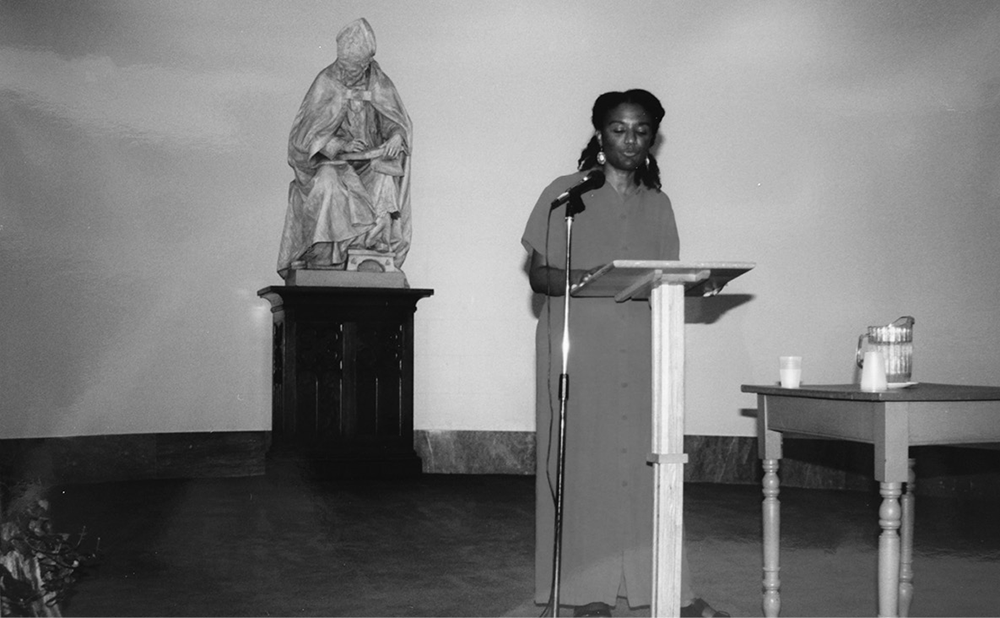
Reading at Cave Canem, at Mount Saint Alphonsus in Esopus, New York, 1999. Photograph courtesy of the Cave Canem Records, James Weldon Johnson Memorial Collection in the Collection of American Literature, the Beinecke Rare Book and Manuscript Library at Yale University.
My conversations with Harryette Mullen in Los Angeles this past December took place mostly on foot. Over the course of the three days of my visit, Mullen acted simultaneously as subject and tour guide: we walked around the campus of the University of California Los Angeles, where she teaches poetry, African American literature, and creative writing in the English department; along the cold, windy Santa Monica Pier; through the MONUMENTS exhibit at the Geffen Contemporary at MOCA; in the Mathias Botanical Garden, where she pointed out plants (a ginkgo, a Kentucky coffee tree) that had found their way into her poems; and down the streets of Little Tokyo, dodging Waymos and delivery bots. Mullen owns a car but prefers to use public transportation; she knew which bus to take to the beach and which train to take to the museum. She doesn’t have a cell phone, and pays her fare in coins.
Daily walks in Los Angeles have been a part of Mullen’s practice since she began writing Urban Tumbleweed: Notes from a Tanka Diary (2013), in which she adopts her own version of the classical Japanese form: thirty-one syllables across three lines instead of five, giving her ten syllables for each line, with “this extra one that can just float around,” she said. Itineraries frame her attention, much like the Oulipian rules, lexical constraints, and metrical forms that give shape to many of her poems and books, including her abecedary, Sleeping with the Dictionary (2002), which was a finalist for the National Book Award. (X is for “Xenophobic Nightmare in a Foreign Language.”) She delights in the play between poetry’s musical and speakerly qualities and the appearance of printed words on the page. At our first meeting, over breakfast at my hotel, she suggested that we not tape our in-person conversations and instead type out the real interview later together, in a shared document, and agreed to the recorder only once she had been reassured that she would be able to edit the draft.
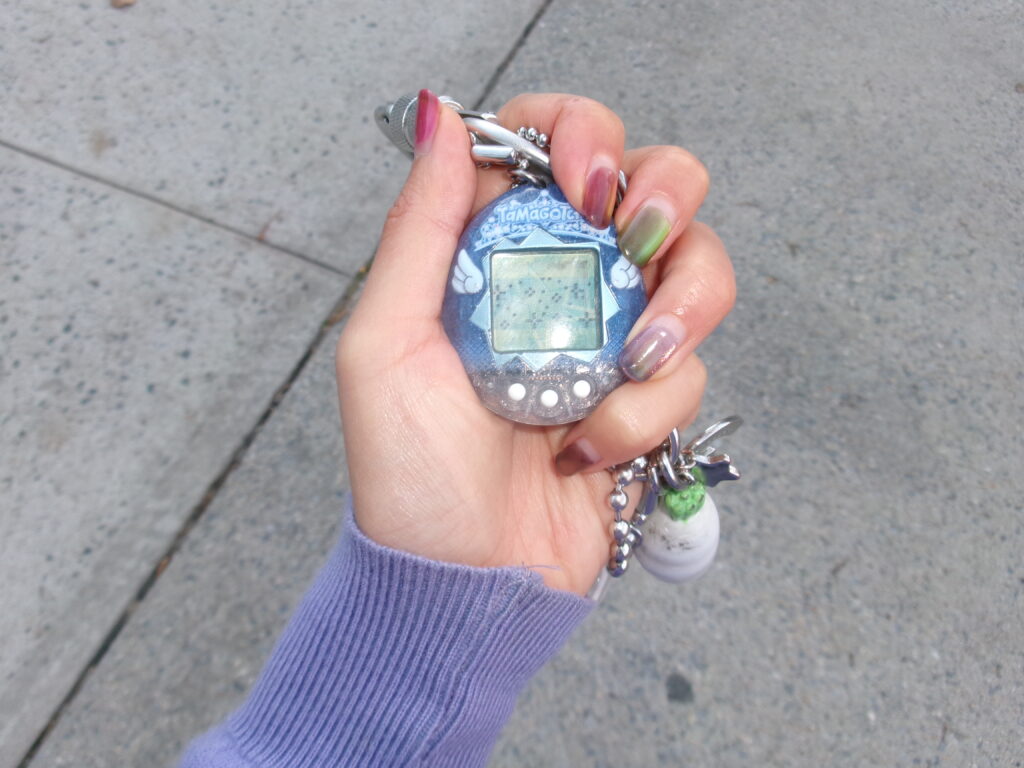
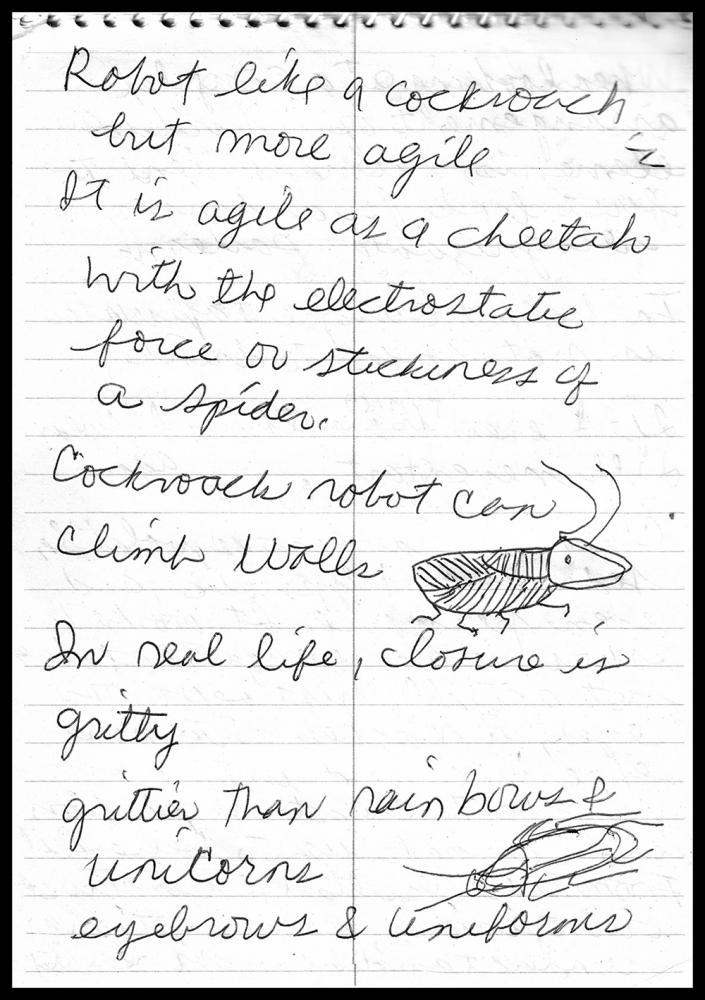
Mullen was born in Florence, Alabama, in 1953. Her father worked at Talladega College and became a social worker; her mother later became a teacher. After her parents’ divorce when she was very young, Mullen and her younger sister, Kirsten, moved with their mother to Fort Worth, Texas, where their maternal grandfather was a Baptist minister. Growing up in black churches and in the South introduced Mullen to many of the cadences and vernaculars that have shaped her poems, including those in her first book, Tree Tall Woman (1981), and other early poems collected in Blues Baby (2002). But her sense of “the tradition” also encompasses the rhythms of popular music; puns, idioms, and games; and works by an extraordinary range of writers and artists, from William Blake to Gwendolyn Brooks to Betye Saar. In Muse & Drudge (1995), she entwines the blues with other lyric traditions; Trimmings (1991) and S*PeRM**K*T (1992) are books of prose poems written in dialogue with Gertrude Stein’s Tender Buttons, the latter of which also riffs on recipes and shopping lists. In Recyclopedia (2006), which collects these three volumes, she invites readers to “Recycle This Book.” Taking pleasure in both the linguistic and the tactile may be one answer to the titular question of a poem in Regaining Unconsciousness (2025): “How Can I Prove I’m Not a Robot?”
Mullen studied English as an undergraduate at the University of Texas at Austin, and earned her Ph.D. in the history of consciousness at UC Santa Cruz. She taught at Cornell before joining the faculty at UCLA, and has taught on and off at Cave Canem since 1999. At the MONUMENTS exhibit, featuring Confederate monuments and artworks in conversation with them, she guided me from piece to piece, parsing them and sharing her reactions. Mullen was drawn to contemporary prints of Jim Crow–era studio portraits by the white North Carolina photographer Hugh Mangum, of multiple clients of different races, ages, and social classes on single glass-plate negatives. Capturing the archival deterioration of the negatives and the diversity of Mangum’s clientele, the prints resemble an unlikely, ghostly family album. Mullen spoke to me about exploring her own family ghosts in a recent short story, “Consanguinity,” inspired in part by her efforts to trace her father’s family history, which led to a branch of white ancestors who were enslavers. As we stood before two carefully arranged piles of bronze ingots made from the Charlottesville monument to Robert E. Lee that was melted down in 2023, we talked of reparations for black Americans. And so the conversation kept moving, between the art in the museum, the political issues of our time, and Mullen’s writings. At the end of the day, we reversed our path and took the train and the bus back to West LA, the recorder still running.
INTERVIEWER
Did you know from the beginning that Sleeping with the Dictionary would be an abecedarian book?
HARRYETTE MULLEN
No. I thought I was writing miscellaneous poems on various subjects that didn’t have a connecting thread. I imagined the book would be called “All She Wrote”—the title of what became the first poem—but then I thought, That’s your epitaph, that’s something for your gravestone. It wasn’t a coherent project until I had the experience of waking up with the dictionary, the hardcover American Heritage, poking me in the back. I remember thinking, Oh, Sleeping with the Dictionary, that’s the title. We often call reference books companions, right? That metaphor gave me a conceptual frame. It was once I acknowledged my writing partner that I decided to order the poems alphabetically. When it was time to turn in the manuscript, I still didn’t have a Y, a U, or an I poem, so I wrote “Why You and I.”
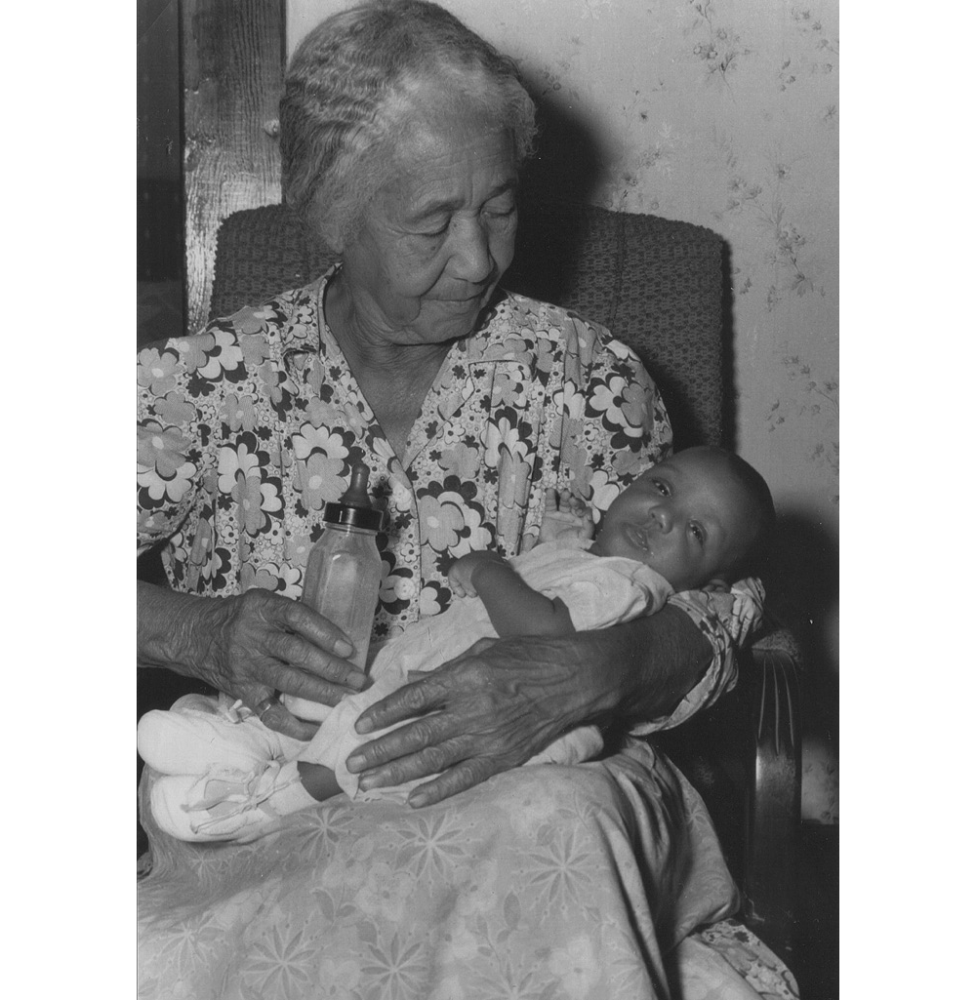
Mullen with her paternal great-grandmother, Ella Mullen, in Florence, Alabama, 1953. Photograph courtesy of Harryette Mullen.
INTERVIEWER
And you often slept with the dictionary?
MULLEN
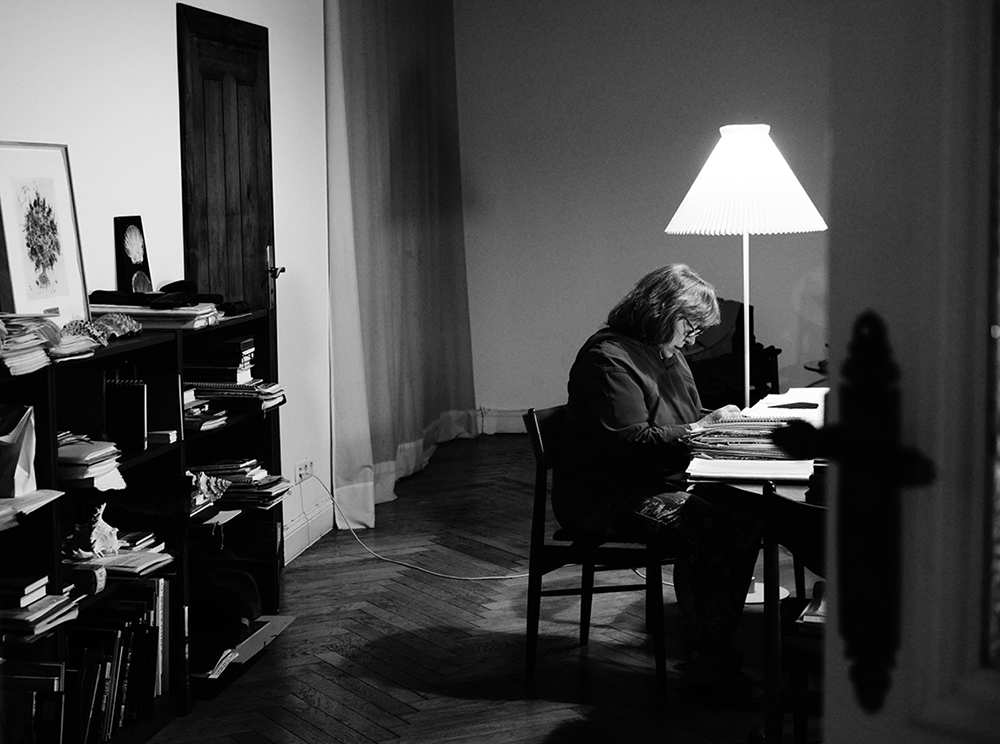
I often go to bed with a book, or I might be scribbling in bed with a dictionary nearby for quick reference. I have a collection of dictionaries and thesauruses—Roget’s and The Synonym Finder, A Feminist Dictionary, compilations of slang and vernacular, bilingual dictionaries, the compact OED with the magnifying glass, and a few dream dictionaries. In this case, the American Heritage woke me. I try to pay attention when the unconscious gives me a hint. Like those lines of iambic that I get sometimes when I wake up. Sometimes trochees, but usually iambs.
INTERVIEWER
Iambs are your first-thing-in-the-morning rhythm?
MULLEN
Yes. “My teeth were made to tear your tender flesh,” “Can blades of grass defend a meadow?” You have to write these things down or they’ll get away from you. I was also reading a book about the Oulipo at that time, and writing a few poems using N+7. Well, not the real thing, but my version.
INTERVIEWER
What is your version of N+7?
MULLEN
It’s a game that makes the dictionary a collaborator. Oulipo writers used N+7 as a formula, a mechanical process to alter a preexisting text. What I took from them was the principle of substitution, the idea of transforming a text by substituting a word that has a similar sound or starts with the same letter or is a synonym in slang. “Dim Lady” and “Variation on a Theme Park” and “Junk Mail” were written that way.
INTERVIEWER
How about the way you use the words bitter labor in “Xenophobic Nightmare in a Foreign Language,” that poem based on the text of the 1882 Chinese Exclusion Act?
MULLEN
Bitter labor is an approximate translation of kuli in Chinese. In English, kuli became “coolie,” a racist epithet for Asian workers. Every time the law mentioned “Chinese laborers,” “Chinese person,” or “Chinese laborer,” I substituted bitter labor.
Several poems in Sleeping with the Dictionary are in some ways topical, in some ways critical. “Bilingual Instructions” I wrote when I moved to California. We had a Republican governor, and citizens had voted against bilingual instruction in the schools. But in Los Angeles we all had roller bins, trash bins for each household, with instructions in English and Spanish written on the lids. In other cases I was just trying to amuse myself, like “Kirstenography,” which was written to and for my sister.
INTERVIEWER
I love that line “when her smoother and farther wrought her chrome from the hose spittle.”
MULLEN
It’s the same principle of substitution, which, even before Oulipo, I got from “Jabberwocky,” where Lewis Carroll just inserts nonsense words into what is otherwise a brief, conventional narrative of a hero’s journey. That surprising collision of language is what makes it amusingly poetic. A lot of people have notions about writing that are blocking them from writing, but whenever I feel stuck, I can resort to something like that, some kind of parody or substitution.
INTERVIEWER
What do you think are the notions that get people blocked?
MULLEN
They seem to believe you have to know what you’re going to write—that there’s some unique and beautiful idea that just needs to be transferred from your brain to the page. People think they have to write something that nobody ever thought of, but you can write about ordinary stuff. If you start with a rule and then break the rule, it’s possible to surprise yourself. I like that the rule is there for me to mess with. You can take a text, do something to it, do something else to it, like Jasper Johns painting the flag. This is something I talk about with my creative writing students—you can transform something that already exists.
INTERVIEWER
I think sometimes college students want to write grown-up poems and not play games.
MULLEN
They want to be serious. They think games are child’s play. But, according to the cartoonist Lynda Barry, a child enjoys drawing because the paper is a place where something interesting happens. They want to find out, What’s going to happen when I start to draw? Most people stop drawing when drawing becomes a thing to be judged good or bad. In one of her exercises, she has her students put a big X on the page, so it’s no longer blank. Then they write over the X, or inside the triangles. Or you can draw a large cross to make four boxes, and write something you saw, something you heard, something you smelled or tasted, and something you felt or remembered. That’s a way of journaling, but you’ve already marked the page before you begin to write.
INTERVIEWER
When did you realize you didn’t have to start with a blank page?
MULLEN
Some people have suggested there’s a radical break after Tree Tall Woman, but for me poetry was always a way of exploring what can be done with language. I think I’ve always been trying to figure out how to write a different poem from the one before. How can you involve the reader in a little game that you’re playing with yourself? I do remember feeling, though, after Tree Tall Woman, that I didn’t want to keep writing about my life—even when it wasn’t all me, in fact. There may be things about my friends and family in that book, or in Blues Baby, but there’s also a mermaid and other invented speakers. I have a few poems in Tree Tall Woman in the voice of a mother, but I’ve never been anybody’s mother.
I didn’t want people thinking they knew who I was when they read a poem of mine. People described some of those poems as confessional, and I thought, Confessing what? Sylvia Plath scared me. Anne Sexton scared me. There was an aspect of self-dramatization that seemed dangerous to me. You could go so far that you fell right off the edge. I knew I would exhaust myself as subject matter, but I could take something and turn it upside down, inside out, add a few doodads, and that way it would become inexhaustible. There are so many accidents of language that we overlook normally, and in poetry you can call attention to them.