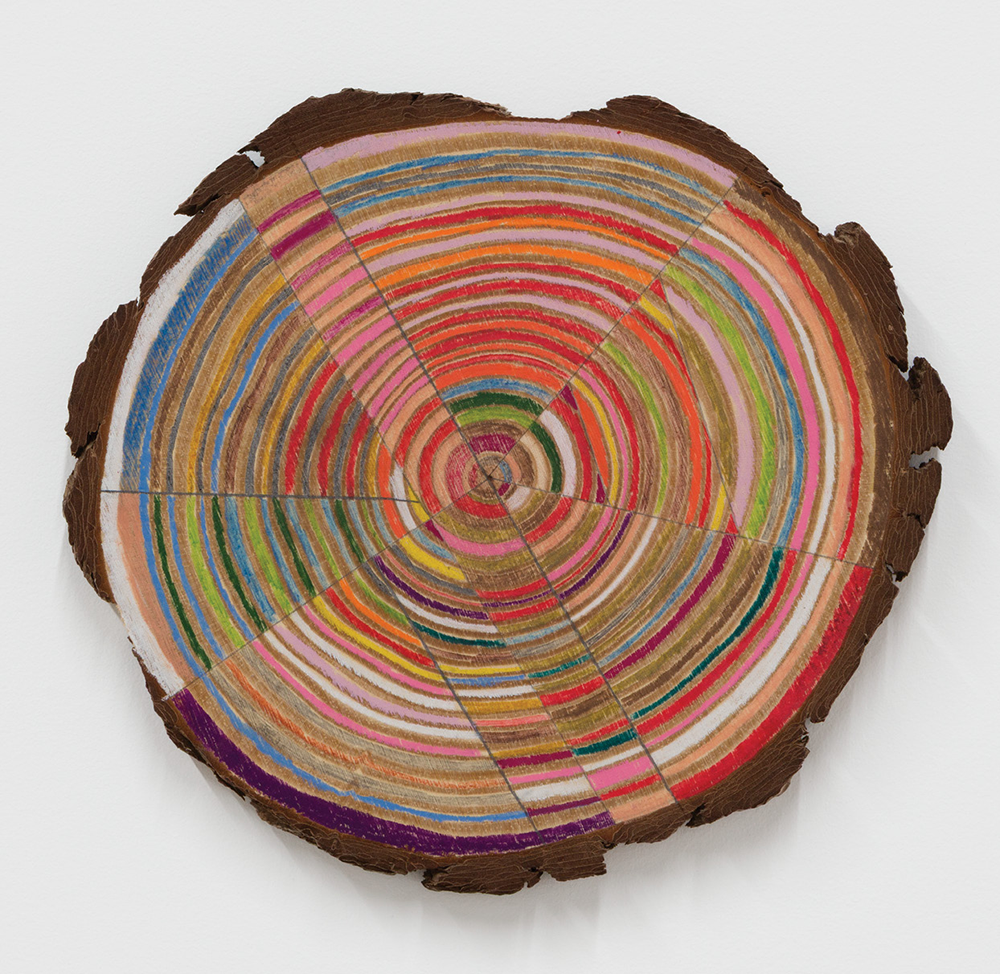
Hannah Tishkoff, Beginning of a Poem, 2026, colored pencil on found wood, 9 x 9.5 x 1 in. Courtesy of Hannah Tishkoff and OCHI, photograph by Deen Babakhyi.
Hannah Tishkoff, Beginning of a Poem, 2026, colored pencil on found wood, 9 x 9.5 x 1 in. Courtesy of Hannah Tishkoff and OCHI, photograph by Deen Babakhyi.
“The Psychic Capital of the World happens to be an unincorporated community in central Florida called Cassadaga.”

In his study in Kaifeng, 1991. Courtesy of Yan Lianke.
When I mentioned to friends in China that I would be interviewing Yan Lianke for The Paris Review, they were politely skeptical. “He hasn’t written anything in a while, has he?” one asked. In fact, Yan, who is the author of more than fifteen novels, remains tremendously prolific, though six of his most recent works—The Four Books (2010, translation 2015), The Day the Sun Died (2015, 2018), Heart Sutra (2020, 2023), The Family Plot (2021, forthcoming 2027), Liaozhai benji (Annals of Liaozhai, 2023), and Yize pangdaer angguide yanyu (A vast and expensive proverb, 2026)—were released in Chinese only in Taiwan and Hong Kong. As he likes to say, he is “the only Chinese writer living in China who isn’t published in China.” But even as his books have been removed from circulation on the mainland—in the case of Dream of Ding Village (2006, 2011), just three days after it reached shelves—his work has also been translated into thirty-plus languages abroad. He is a two-time recipient of the Lu Xun Literary Prize, one of the country’s most prestigious honors, as well as a winner of the Franz Kafka Prize; has had two books nominated for the International Booker; and is frequently cited as one of China’s leading contenders for a Nobel Prize.
Yan was born in 1958, in a small village in rural Henan, about forty miles from the nearest city, Luoyang. He is the youngest of four children, and both his parents were farmers. Much of his fiction has been set among the petty disputes and scandals of his home region; in his memoirs, including Three Brothers (2009, 2020) and The Women (2021, forthcoming 2026), he discusses his ambivalent relationship to his hometown, writing (in Carlos Rojas’s translation) that “I am this region’s unfilial son, an enemy agent, and the reason everyone still smiles when I return is that they don’t know that I’m a traitor to their land.” After joining the People’s Liberation Army (PLA) at twenty, he enrolled in one of its writing academies; his literary ability soon brought him success in the army’s propaganda department, and he reached the rank of senior colonel before leaving the military in 2004.
He got his first inkling of the responses his work would provoke in the nineties, when he was still in the army and one of his stories was deemed suspiciously anti-war. He ran further afoul of the authorities with Serve the People! (2005, 2007), a satirical novel in which two lovers arouse each other by defacing icons of the Cultural Revolution, then with Dream of Ding Village, a dark fable based on the story of a real village in Henan Province whose residents were left HIV positive after selling their blood to unscrupulous blood merchants. In the years after that, it became steadily more difficult, then impossible, for Yan to be published in his home country, although no official ban on his work exists.
That obstacle has spurred him to become more daring, both formally and politically. The Four Books is set in a labor camp during the famine of the Great Leap Forward, and is told through a collage of text fragments written by different prisoners: a diary, a philosophical treatise, notes for a novel by “the Author.” Yan often writes himself into his works, winking at his own predicament. In The Explosion Chronicles (2013, 2016), the famous author “Yan Lianke” is personally invited by the mayor of his (fictional) hometown of Explosion to write a book documenting its transition from a small village to a metropolis—only for the writer to reveal so much of the city’s dirty laundry that the local government labels him persona non grata.
I spoke with Yan last autumn in his rather austere office at the Hong Kong University of Science and Technology, where he serves as visiting faculty, and then again this spring, in his much cozier apartment near Renmin University of China in Beijing, where he teaches creative writing. (He has lived in the city since 1994, when he arrived with his wife, Zhai Lisha, and their son.) During our conversations, he offered me tea and a selection of dried fruit, nuts, and pastries; when he heard that I was staying with my friend the author Zhang Yueran, he insisted I take her a special bag of red rice, known for its health benefits, to pass on to her father, who wasn’t well. We met in the afternoons so that he was able to write in the mornings, on the easel-like setup on which he pens two thousand characters by hand each day. Yan speaks in a placid tone, even when talking about his terror of death, and always in complete paragraphs, in a Henan accent undiminished by his decades in Beijing. Every so often, he would slip into the third person, as if describing himself as a character in his fiction, or sometimes into the second person, as if addressing his past self.
INTERVIEWER
Thanks for meeting me, Mr. Yan. Tell me, do you find the environment here in Hong Kong more conducive to writing than Mainland China?
YAN LIANKE
First, thank you for coming all this way. I’ve been teaching here for twelve or thirteen years now, every other semester, for half a day a week, which leaves a lot of time to write. The longer I spend on the mainland, the freer I feel here. It really does seem as though I could write anything I like with no worries. I’ve written a great deal in the past decade or so, and that’s in part because I know that my books can’t be published in China. You have to understand that China has an enormous market for books. Almost every year there are books that sell a million, maybe two million, copies, which is a huge incentive. Say you earn six yuan per book—that’s six million yuan if you have a million sales, more than most people can earn in a lifetime. I don’t think I could resist that either. But when you write with the hope of being published in Chinese, you’re entering a state of constraint, because the market is subject to China’s legislation. I often say that the frightening thing isn’t official censorship, it’s self-censorship. When you censor yourself, that’s far more serious than someone else censoring you. But if I don’t have to think about being published, then I can write anything I want, without any restrictions.
INTERVIEWER
Have you always been so sanguine about being banned?
YAN
The thing is, I was publishing at a time when China was more liberal than it had been before or has been since. My novels Riguang liunian (Streams of time, 1998), Lenin’s Kisses (2004, 2012), and Hard Like Water (2001, 2021) were widely read and talked about. Huang jindong (The golden cave, 1995) and The Years, Months, Days (1997, 2017) were recognized by the Lu Xun Literary Prize. I also won army-wide prizes for literature and playwriting. The military came to value Yan Lianke, someone who’d won four national prizes and never asked for a single thing. My attitude was, Just let me write, don’t bother me—that’s all I want. It’s not that I was particularly courageous but that China was more tolerant then. Yes, Serve the People! was criticized and censored, but the fact that it got published speaks for itself.
I was slow to realize it when the walls started closing in. I thought I would be fine publishing Dream of Ding Village, but I got into trouble. Then I wrote Feng yasong (Ballad, hymn, ode, 2008) and spent half a year revising it through various rounds of censorship, which was all wasted time. I must have rewritten it six times and gone through four publishing houses. Just as one publisher was preparing to bring it out, their friends would call them to say, “Don’t touch Yan Lianke’s books, you’ll be censored by the authorities.” I was pushing fifty at that point, and I realized that my life was slipping away, and that it wasn’t just other people who were unhappy with my writing—I didn’t like it either. I thought, If I’m never going to be able to write something that other people approve of, then at least I can make sure I’m happy with what I write. My mind was completely clear when I began The Four Books. From then on, I’ve spent a lot of time thinking about the form of the novel. You can see from The Explosion Chronicles, The Day the Sun Died, The Family Plot, and Liaozhai benji that when an author is no longer working toward publication, he has the greatest freedom.
INTERVIEWER
Why is it that, with the freedom to write about anything, you’ve so often chosen to write about rural villages that resemble your own hometown?
YAN
I started writing about rural life when I was in the army. I’d read a lot of revolutionary rural literature of the kind that came into vogue after 1949, but the characters in most of those books—Zhou Libo’s The Hurricane, Ding Ling’s The Sun Shines over the Sanggan River, or Liu Qing’s Chuang yeshi (History of entrepreneurship)—had very little in common with the villagers I knew. Nor did I see them in the wave of so-called scar literature published in the seventies and eighties, which dealt with the aftermath of the Cultural Revolution, much of it written by the “educated youths” who were sent down to the countryside. I had nothing in common with these educated youths who were billeted to the village where I grew up, and who, from what I could see, were all better off than us. I envied them deeply. They didn’t have to do farmwork like we did. We fed them our best food even though we barely had enough for ourselves. I can see why those authors—Wang Anyi, Han Shaogong, Li Rui, Liang Xiaosheng, and so on—would write about their years of hardship, being separated from their families and sent away from the cities, but not a single one of them considered that the farmers in whose villages they were living had endured injustice and suffering for two or three thousand years.
So I want the books I write to be quite different, to be the kind of writing that only someone from the countryside could have come up with. Wherever I find the seed for a story, I try to plant it in familiar soil. Something from the countryside can’t be planted in Beijing.
At right, as a new recruit in Shangqiu, Henan, 1978. Courtesy of Yan Lianke.
INTERVIEWER
Is it a kind of nostalgia or homesickness that keeps you returning to the subject of where you come from?
YAN
I don’t think there’s any homesickness in me at all. Chinese writers love to imagine themselves as Odysseus, yearning for home, but I’ve always wanted to get as far away as possible. Even as a child, I longed to leave my village and go to the big city, which at the time meant Luoyang. As the Cultural Revolution was winding down, when I was fourteen or fifteen, and the educated youths were returning to their cities one by one, I started riding my bicycle the sixty kilometers there for a part-time job. It was the first time I’d seen such tall buildings, three or four stories high. I marveled at the buses and the way every window was lit up at night. Much later, after studying for two years in Beijing, I decided I had to find a way to stay. Then, after moving to Beijing permanently, I had a hankering to go abroad, like the young people in The Family Plot who want to move to America, lured by a certain sophistication. Most of the stories I’ve written recently are about people wanting to leave the place they come from. They don’t know where they’re trying to go, but they need to get out.
INTERVIEWER
You talk about the lure of the city, but don’t The Explosion Chronicles and The Family Plot suggest that, as rural villages expand and become wealthier, their inhabitants tend to lose their moral compasses?
YAN
I’ve written about all the problems wealth brings, but also about the difficulties of being poor. Humankind lives in an eternal dilemma. You’re in a terrible situation either way.
INTERVIEWER
Could we say that your real subject is power, then? People are powerless when they’re poor, and after gaining power, they use it to oppress others.
YAN
Gaining the power to control others is a terrifying business. I’m currently writing a novel that includes all the revolutionaries who emerged after the Qing dynasty—Sun Yat-Sen, Chiang Kai-Shek, Mao Zedong, Zhou Enlai, Deng Xiaoping, and so on, along with fictional characters from other people’s work, as well as Lu Xun, Hu Shih, and virtually every other Modernist writer. And the writers who killed themselves during the Cultural Revolution, like Lao She and Fu Lei. Obviously, the novel is unpublishable, but I’m strongly drawn to writing it. If only there were no such heroes and we could all calmly live our lives. In any case, I won’t discuss the plot in this interview. Let’s just say that I’m writing a book that I plan never to publish. I’ll leave it to my son, and maybe he’ll pass it on to his children. Maybe, far in the future, people will read it and know that their ancestors once thought and wrote in this way.
INTERVIEWER
Did your parents pass books on to you? What did you read as a child?
YAN
My parents were illiterate, but my eldest sister was a big reader, partly because she was ill and spent a lot of time in bed. I don’t know where she borrowed all those books from, but I liked to say that her bedside table was my personal library. These were all revolutionary novels—what China calls red classics. When I was sixteen or seventeen, I came across Zhang Kangkang, whom you might not be familiar with—the 1975 novel she’s best known for, Fenjiexian (Boundary line), isn’t much talked about today. It’s a revolutionary novel about class struggle. I can’t remember how I found out that she’d been sent down from her hometown of Hangzhou to a farm in Qiqihar in the Northeast and that, after writing the novel, she was transferred to the city of Harbin. That got me thinking—if writing a book could take you from the middle of nowhere to a big city, why shouldn’t I write one? I was at school during the day, and on weekends I had to work in the fields, so I could write only at night—by the light of a kerosene lamp, because we didn’t have electricity back then. After two or three years of this, I’d produced my own novel of three hundred and ten thousand characters, all handwritten.
INTERVIEWER
What was the novel about?
YAN
My mother was married off when she was sixteen or seventeen—back then, families would adopt young girls and raise them as future daughters-in-law. She had no father and lost her mother when she was an infant. I took my mother’s story and borrowed liberally from the revolutionary novels I’d read to write my own novel of class struggle. A film came out a few years later called The Little Flower, about a young woman, played by Joan Chen, whose brother goes missing during the revolutionary war. I saw it when I was in the army, and thought the plot was quite similar.
Subscribe for free: Apple Podcasts | Spotify | Amazon Music