Christo is an artist whose temporary environmental monuments have consistently involved the real world outside museums and galleries. His “projects” are enormous. He has wrapped sections of the Sydney, Australia coast in acre-sized tarpaulins; he has done the same with a bank in Berne.
His most complex American project (before “Running Fence”) was realized in Rifle Gap, Colorado in 1971 where Christo and an army of workers suspended a huge orange translucent curtain, 1300 feet wide and 350 feet high, across a canyon where it hung for a few hours until a windstorm tore it down.
Though a finished structure is the aesthetic completion of Christo’s idea, it is only the tip of the iceberg. For Christo, the organization of the project, the documentation involved, the human and bureaucratic encounters necessary to produce the final structure are a major part of the work. His confrontation with social and environmental forces is deliberate. His deepest interests lie in dealing with them, just as a politician appreciates the process of a political campaign. “Valley Curtain” of Rifle Gap took two years of intensive planning and engineering—with much of Christo’s delight derived from watching the community’s attitude evolve from scepticism to enthusiasm and finally support as the project grew.


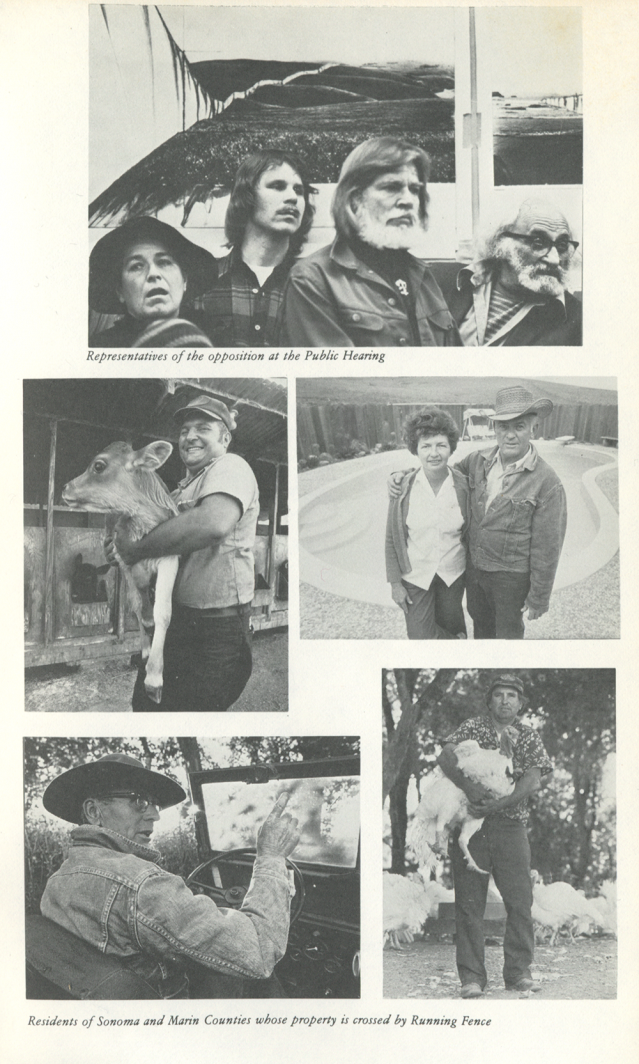
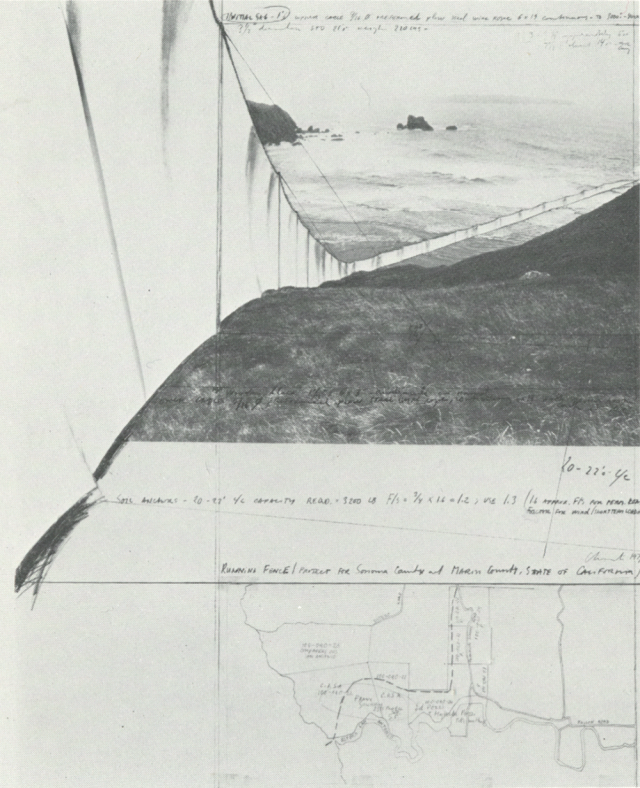
On a grander scale, he is going through a similar progression with his newest project: the Running Fence, 18 feet high, will emerge from the ocean and follow an undulating path inland across 24 miles of private properties in Marin and Sonoma Counties, California which is an area of far more complex socio-political-economic pressures than in the canyon of Rifle Gap. The idea of the fence has produced a palaver of responses from the community. While all 59 landowners have now given permission for Running Fence to cross their land, the controversy continues at public hearings and within the larger economic and art communities around San Francisco.
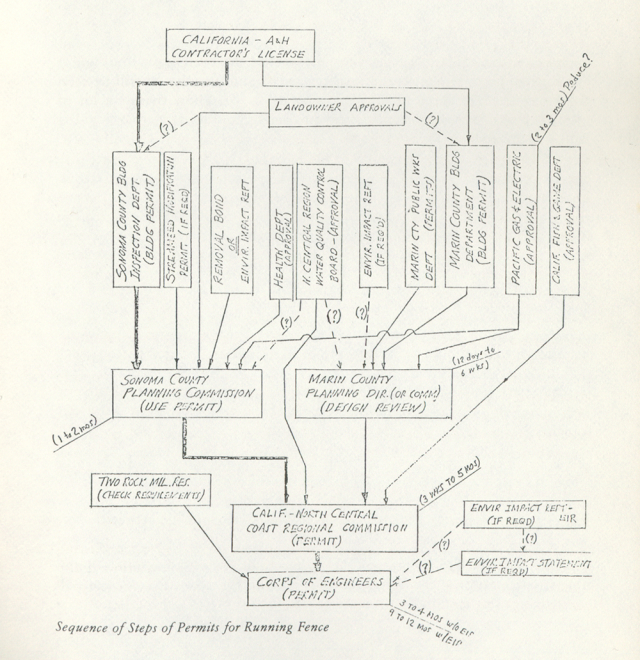
What follows is a portion of a “Fact-Sheet” given to the Board of Supervisors, and excerpts from the public testimony at a hearing called to discuss Christo’s project. If all goes well, Running Fence will exist for two weeks in September, 1975.
FACT SHEET
1. The Running Fence will be a heavy, white nylon fabric (165,000 yards), hung from a steel cable strung between 2,270 steel poles. The poles, generally 62 feet apart, will be embedded three feet in the ground and braced laterally with guy wires and earth (or rock) anchors. The lower edge of the fabric will be attached to a bottom cable anchored to the ground at about 20 foot intervals.
2. The Running Fence will be a two phase operation. Phase I, installation of the relatively inconspicuous structural parts, will take about five months, and will commence in April, 1975 (ed. note: Construction began in May).
Phase II, installation and tie-down of the entire 24 miles of 2,270 fabric sections, is planned to take place in two days, Monday and Tuesday, September 15th and 16th.
3. It is intended that the fence will remain complete for two weeks. However, if it does present a traffic or other safety problem, then that portion of the fence will be immediately dismantled. At the conclusion of the two weeks, the whole fence will be dismantled, and all its components will be removed.
4. The fence poles will be set in the soil, not in concrete, and adequate space will be provided between the bottom of the fence and ground for the passage of wildlife. A biologist shall oversee construction and removal of the project to insure that it will not have an adverse impact on the wildlife and plant life. Upon removal of the fence, the environment will be fully restored to appear just as it was prior to installation.
5. A minimum of 20 full-time people will be involved over approximately six months. For several weeks there will be more than 300 students and others employed.
6. Eighty trained monitors, equipped with communication equipment and motorbikes, employed in shifts around the clock, will protect the areas surrounding the fence. In addition, vehicles used in the construction of the fence will have fire prevention equipment. A fire fighting plane of the Forest Service will be on call. Christo will pay for an extra squad car and additional off-duty officers to police the area.
7. The cost of the materials and labor necessary to complete this project are approximately $1,050,000.00. The entire amount has been raised by Christo through the sale of his graphics, drawings and other works of art.
8. The Running Fence is designed to sustain winds not exceeding 55 to 60 miles per hour. If winds occur in excess of 60 miles per hour, the upper clips will give way and the fabric will slide down to the ground and will be held by the vertical and lower clips.
9. Christo has agreed to obtain a bodily injury and property damage policy of not less than $1,000,000.00. He will post a removal bond in the amount of $100,000.00 to insure compliance with the permit and that the land is restored to its original condition.
10. Since the Running Fence is an expression of art and not a commercial venture, no effort will be made by Christo to encourage anyone to view the project, not will he sell any of its by-products.
Upon completion of the project, the only evidence that will remain of the fence will be the preliminary drawings and sketches by Christo, a book and a documentary movie similar to the “Valley Curtain.”
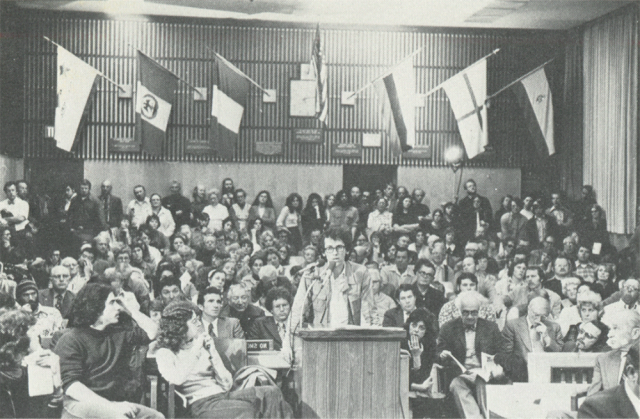
TESTIMONY FROM THE PUBLIC HEARING
Christo: It’s hard to explain that the work is not only the fabric steel poles or fence. Everybody here is part of my work. Even those who don’t want to be are part of my work ... It is nothing involved with the make-believe. The part of my project is very much to live the real life a little bit like an expedition going to New Guinea or to the Himalayas ... But I believe strongly it is beautiful because the fabric is a woven nylon and conductor of light and at sunset it will appear as an incredible ribbon of light transversing through all these fences. It can never be seen in its entirety. It will be seen from public roads three or four miles apart ... I know there’s a lot of outrage at the considerable cost of my project and at the effort that is going into it. But all my money is mine. We haven’t a cent from any foundation or any art institute or governmental organization. It’s cheap when you think that our capitalistic society can spend five million dollars for less than half an hour watching Muhammad Ali beating somebody. And no one objects to this five million ... After completion not one thing will be left—all the material will go back to the ranchers for whom they have a very direct use—these 59 ranchers who will lease their land. We pay rent for their land and we give back all the poles—2200 steel poles—and give all the fabric of the fence back to the ranchers.
Artist: The Running Fence Corporation was incorporated in Illinois. Its principals are residents of New York. Its money comes largely from Europe. Its engineers and principal contractors are from Colorado. The cloth is manufactured outside California. The sewing is being done outside California. The mechanics and posts are being developed largely in Wyoming. The structure was tested and developed in Wyoming. Even the pipe was made in Japan and Germany. The fence is a fraud. It all exists for the publicity and glory of one man. It is for his ego and his profit. Are we a bunch of hicks rolling over for the medicine man and his sideshow, awestruck by the man from the big city?
Unidentified Female: Bid this carpetbagger ‘adieu’!
San Francisco Art Critic: When Michelangelo came to paint the Sistine Chapel, .some monk or bishop or some cardinal probably questioned the rationale preceding that decision. Unquestionably, the same concern will be raised about the Christo Running Fence.
An Artist: I’m sorry but I cannot call this art. What I see in this curtain business, and from the Bible and from my knowledge in history, it’s all a forerunner for land developers. It takes me back to the early thirties in Paris, the Café de Dome, which as a meeting place for artists became the flea market for all sorts of opportunists, camp-followers, and barnacles on the honest artists. Besides that, I talk six languages and care for the United States.
Farmer’s Wife: We raise potatoes and I don't think this fence is going to bother any of this.
Opposition: I’m not discussing art, I’m talking about public hazard, the litter and mobs. Every road will be jammed and when you get mobs and traffic jams, people become anonymous and dangerous, they don t care about public property, and they’ll break down fences—it will be like a rock festival.
Opposition: You’re going to have a lot of people in all those little narrow roads. I think a million dollars is just a perfectly ridiculous endemnity bond; ten million might be all right, twenty-five million would be better.
Rancher’s Wife: You objected to the traffic. If you were going to turn it down just because of the traffic, you would have to abolish the wrist-wrestling, the fairs. Mother’s Day and Easter ... because there’s a lot of traffic in Sonoma County on those days, particularly Easter and Mother’s Day.
Housewife: One of the things that really surprised me at the time was so many statements prefaced by “maybe” and “what if.” I wonder if the Board of Supervisors of Sonoma County would ever get anything done if every morning they got up and went to their cars and said “Oh. I wonder if I’ll get to work today. I wonder if there’ll be an accident ... ” If you’re going to be afraid of everything because of what might happen, nothing will happen.
Peace & Freedom Party Representative: We should support Sonoma County artists. There are a lot of famous, near-famous and just very good artists here in Sonoma County. Why should someone from the outside come in and show us how it’s done ... This has very little cultural value for the residents of this county I think. Our style is more rural, less flamboyant than this kind of thing. The whole project ... seems more like an elegant hustle than a really great art event.
The Opposition: We feel it would constitute a public nuisance. It would be creating an annoying, unpleasant and obnoxious experience for the people who must try to do their business in the area of the proposed project. It certainly would be an annoying, unpleasant and obnoxious experience for me to have to look at and live with this alleged art work.
Sculptor: An artist is not the same thing as a corporation. I for one hope the days are over when a length of rope in an empty gallery or a piece of Detroit reject fabric temporarily defacing a landscape will make art critics rave and tell the innocent public they are ‘far out.’
Rancher’s Wife: There was one criticism about the art being “temporal.” My husband is a farmer and I am a housewife. Some of the meals I prepare aren’t much. But sometimes I go lo a lot of work to prepare a meal that I think is “art.” It’s a masterpiece. And what happens to it? It gets eaten up and disappears!
Rancher’s Wife: As for the people who feel that a million dollars should be spent on welfare in this area instead of for the fence, how many of them realize that when money is earmarked for a certain project it is spent for that project? It is not given away if the project is abandoned. If this project is abandoned here, Christo will spend the money somewhere else. It will not go to welfare for that is not his dream.
Rancher: I feel it’s just obviously fraudulent. It isn’t art. A curtain 10 feet long and 18 feet high is not art; it’s not art if it’s 24 miles long.
Sheeprancher: I don’t know nothing about art. I think that if anyone wants to come into our county and dump a million dollars, I’m for it. I’ve been talking with an awful lot of ranchers and I haven’t found one rancher against it. They’re all being compensated for putting this thing up; they’re getting the material, plus compensation. I can’t see taking that away from the ranchers.
Rancher: I am a property owner up in north Marin County, and I’m third generation myself and I can’t wait for Christo to come and go so I can use his pipes and cable. I have a sheep and dairy operation and you know how the price of posts are today. I think when it’s all over with, you’ll agree with me; you’ll be glad they came to Marin County,
Christo: There are many reasons why I chose California, California is one of the American states par excellence where the rural, urban and suburban, all conflicting, so profoundly show so much our twentieth century feeling.
—F.B.H. and A.A.