Issue 255, Spring 2026
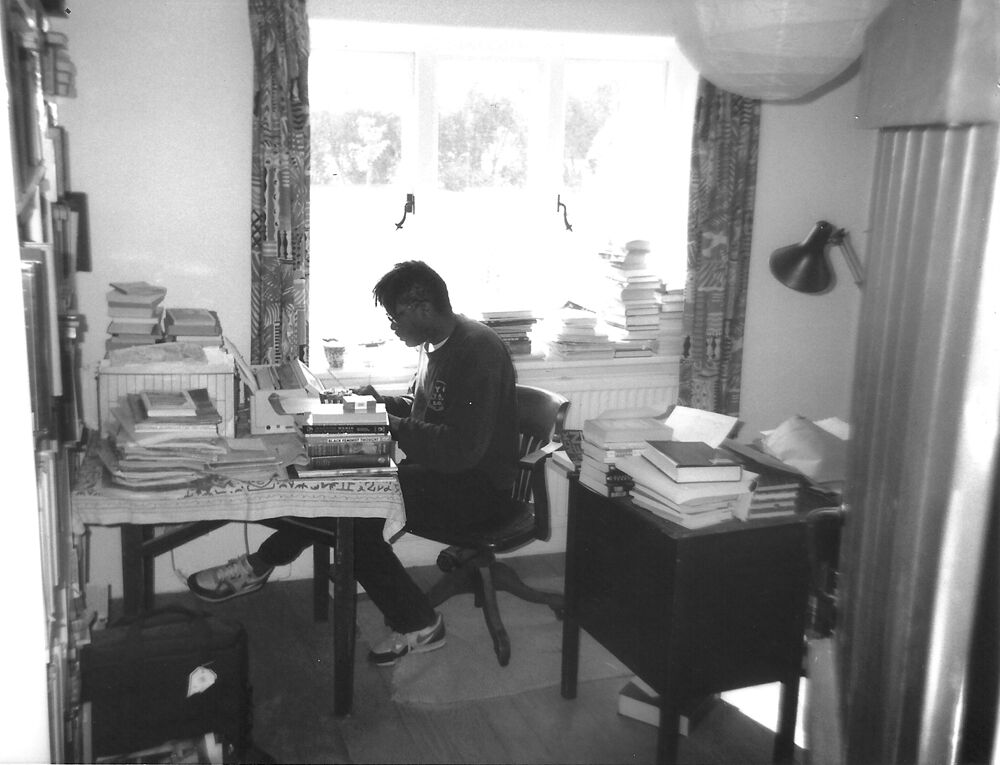
At Long Leys Farm near Oxford, England, 1993. Photograph courtesy of Darryl Pinckney.
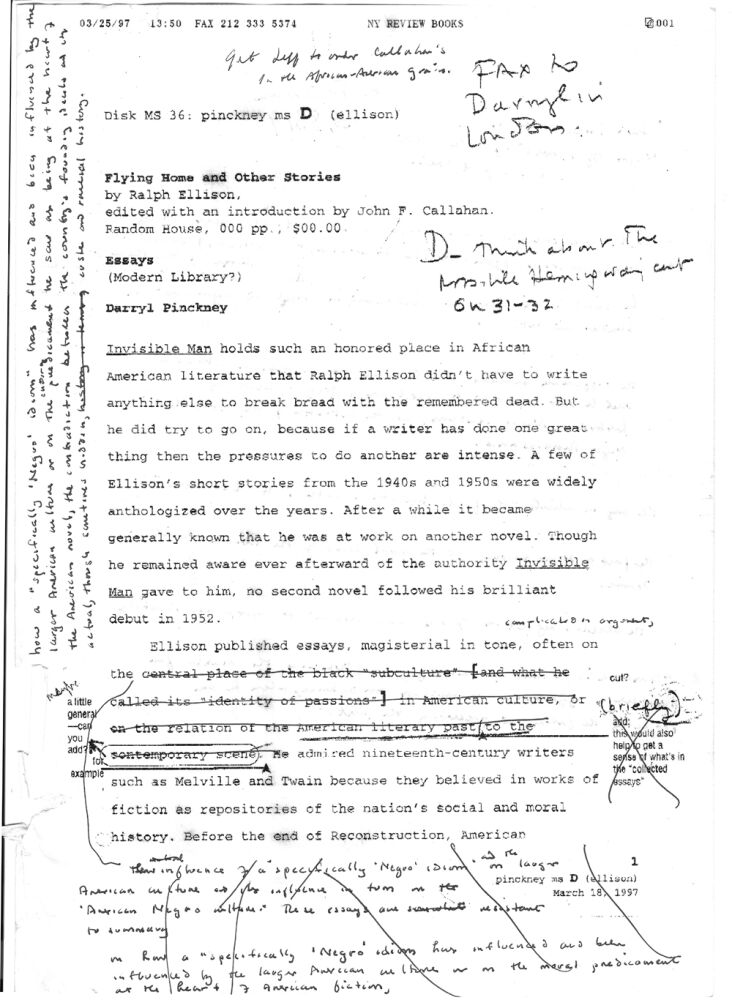
Over the course of half a century, Darryl Pinckney has produced a body of work, riveting in its insight and philosophical in its scope, whose primary focus is the making of black history itself. Pinckney takes to the extreme the old saw that the book review is an excuse for the critic to write not on the book but on its subject; in his long, lyrical essays for The New York Review of Books, he might gather eleven volumes to illuminate the unstable concept of the black aristocracy, or he might explain how two memoirs by newspaper journalists recall the expectation, dating back to the 1789 publication of Olaudah Equiano’s slave narrative, that autobiographies by black writers “will tell of the journey from Can’t to Can.” A review of Barry Jenkins’s Moonlight invokes Zora Neale Hurston; a piece pegged to a book on Barack Obama’s 2008 candidacy refers to predictions made at Pinckney’s barbershop. A more recent piece on the Zimbabwean novelist Tsitsi Dangarembga begins with disquisitions on Doris Lessing and the literature of the psychological effects of colonialism. Only then does Dangarembga emerge from the wings, and by that point the reader trusts that wherever Pinckney wants to take them will be the right place to go.
Given his painstaking methods, it is not entirely surprising that “Sold and Gone: Essays in Twentieth-Century African American Literature,” an expansion of his writings in The New York Review of Books, has been forthcoming for more than three decades. Pinckney’s books of nonfiction include Out There: Mavericks of Black Literature (2002), Blackballed: The Black Vote and US Democracy (2014), and Busted in New York (2019), a collection of reportage and first-person essays full of poignant humor. In “Slouching Toward Washington,” he describes standing for “Lift Ev’ry Voice and Sing” on the eve of the Million Man March in 1995: “I half expected to hear my mother’s alto at my shoulder.”
Pinckney was born in Indianapolis in 1953 to Aurelius Dewey Pinckney Jr., a dentist, and Claragene Pinckney, both active members of the local chapter of the NAACP. He attended Columbia University and took a class at Barnard with the literary critic and novelist Elizabeth Hardwick, who became his mentor; in Come Back in September (2022), he conjures the atmosphere of his time spent with “the three stars of the great table of contents that was Manhattan”—Hardwick, Susan Sontag, and Barbara Epstein, the founding coeditor, with Robert Silvers, of The New York Review of Books. In the late eighties, having become a regular contributor to that magazine, Pinckney moved to Berlin, where he met the avant-garde theater director Robert Wilson. Their collaboration—Wilson as director, Pinckney as dramaturge—began with a retelling of Gilgamesh called The Forest (1988), with Heiner Müller and David Byrne as coconspirators, and has continued through Mary Said What She Said (2019), about Mary, Queen of Scots, starring Isabelle Huppert, which had its New York premiere last year. Pinckney is also the author of two semiautobiographical novels: High Cotton (1992), whose nerdy, Anglophile narrator is poised to join the fourth generation of his father’s family to graduate from college, and Black Deutschland (2016), about a gay man from Chicago who follows in Christopher Isherwood’s footsteps and moves to Berlin, fleeing American racism and seeking sexual freedom. During our sessions, Pinckney revealed, and then somewhat regretted revealing, that he is at work on a new novel, set in Timbuktu and Tudor London.
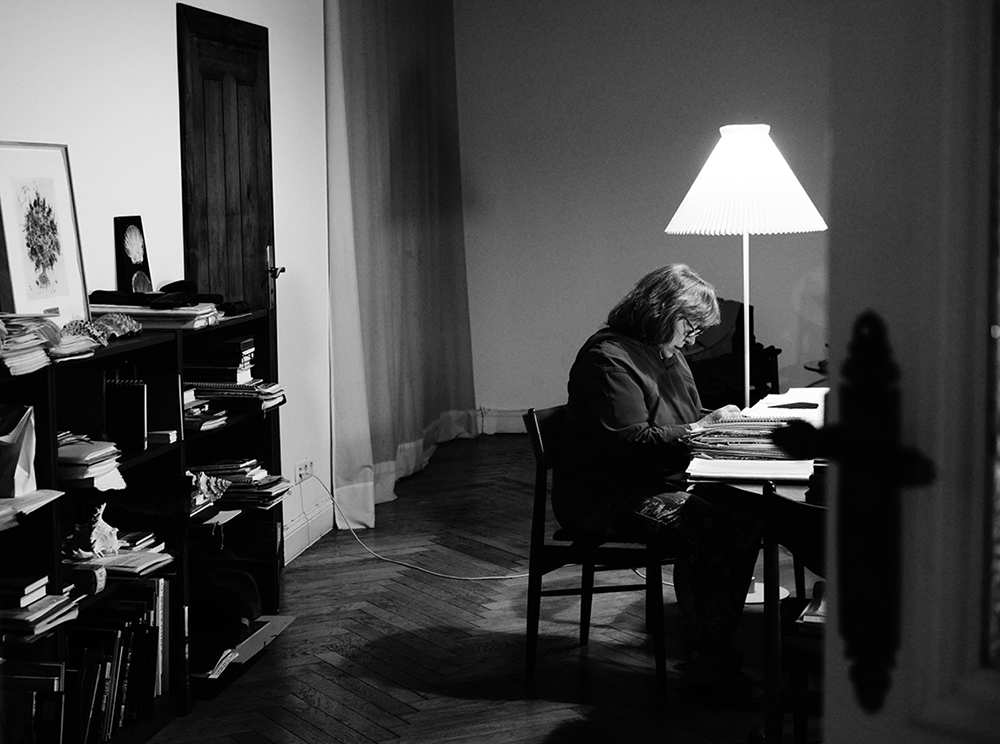
Pinckney lives in Harlem, in a Gilded Age mansion on Marcus Garvey Park that his partner of thirty-six years, the English poet James Fenton, who has a zeal for architectural history and interior design, has been working since 2010 to restore. It is both a masterpiece of period detail and completely unmanageable as a residence for two; the house is on the market, and the couple hopes to return to England. This interview stretched across five meetings, from last summer until after the election of Zohran Mamdani. Each session began in the kitchen, where on Halloween I found Fenton, also the cook of the couple, trimming the twine on a gargantuan roast with what appeared to be a dagger. Pinckney and I would proceed up a creaky wooden staircase to the parlor floor, where the walls of the music room are hung with a hot-pink textile work by David Hockney and a Mughal embroidery. We would take our seats at a round table in the oval-shaped, wood-paneled former dining room. Through the curved doorway at the back, I could see the corridor of their working library. My interlocutor was patient and playful, with a humility that often veered into self-deprecation. Occasionally Fenton would pop his head in, either to announce that lunch was ready or to coo encouragingly, and Pinckney’s face would light up.
INTERVIEWER
In your recent essay on James Baldwin in The New York Review of Books, you wrote, “However originality happens, Baldwin doesn’t sound like anyone else. His immediate appeal is in his startling personality as a writer.” What is it about his personality that has kept you interested all these years?
DARRYL PINCKNEY
Gee. What does someone’s “personality as a writer” mean to you?
INTERVIEWER
Voice?
PINCKNEY
I think primarily. And Baldwin has this unmistakable voice. The appeal is that it’s at once literary and speakerly. I think the writers, the essayists I’m drawn to have that quality. Certainly Lizzie—Elizabeth Hardwick. Virginia Woolf in her essays—you get her right away. [William] Hazlitt would be another. It’s sort of immediate how very observant he is, and empathetic. I like [Thomas] Carlyle, but his isn’t a speakerly voice at all. He’s got a lot of steel or iron.
INTERVIEWER
Is that fusion of literary and speakerly something you’ve aspired to in your own essays?
PINCKNEY
Probably. But it’s not so conscious. You either have that quality when you’re writing or it’s just not there. You judge it for yourself as you do it.
INTERVIEWER
Are you a harsh judge of your own work?
PINCKNEY
Isn’t everybody? Although I suppose I do wonder of certain people if they ever rewrite anything. And some people have such terrific fluency that they don’t have to. I used to be able to tell, when James was walking around the rose garden, whether he was writing prose or poetry by his gait, the rhythm. When he writes something down, it’s the last thing, because he’s already thought about it and thought about it and thought about it. But I don’t know what I think until I write it down, so the first draft is never going to be anything except the roughest attempt.
INTERVIEWER
What kinds of revisions might you make?
PINCKNEY
With the Baldwin essay, for instance, I discarded most of what I had. I’d started with a completely different idea, which came from reading two children’s poems Woolf wrote for her niece and nephew that were published recently in the Times Literary Supplement. It made me think about writers who people want to read anything and everything by, for whom there’s always a market. People are so interested in the real Mrs. Dalloway. Where does that interest come from? Not just that level of interest but that kind of interest, where you think the life is somehow the key to the work. I was going to start there, because it seems to me that Baldwin has gotten to that level of celebrity. The question of whether or not he ran off with Marlon Brando one night comes up several times in the new biography I was reviewing. I don’t fault anyone for wanting to know that kind of thing, but to me it’s not the most important. I don’t know what to call it. It’s something else. As interested as I am in writers’ lives, and as devoted as I am to the biographical essay as a form of literary criticism, these days I sometimes miss the literary emphasis. In the end, Baldwin’s novels, Woolf’s novels, anyone’s novels are trying to escape the writer and live their own lives.
INTERVIEWER
Come Back in September, though, is so much about how personal circumstances and private conversations shape what gets written.
PINCKNEY
Well, that’s just luck. I was trying to be true to what Lizzie said and what she stood for, what she was going through, including with Robert Lowell and his use of her letters in The Dolphin. And so the theme of how to use biographical materials naturally emerged, because these questions were always on her mind. She certainly used the writer’s life to inform her sense of their work, but I suppose I inherited her point of view, in that she sort of said, Don’t read the biography of anyone you knew well. It won’t be that person.
I think of the memoir as a sort of history of that time, in which Lizzie was one of the stars I was close to. It was a huge piece of New York good fortune. I’ve always responded to the form of a work like [Johann Peter] Eckermann’s Conversations of Goethe, The Golden Notebook, Alexander Herzen’s memoirs, the Berlin diaries of Marie Vassiltchikov. You might see this as excusing my prurient tendency toward gossip, but it’s an interesting form of narrative history, which is the kind of history I like best.
INTERVIEWER
How do you balance the life and the work in a biographical essay?
PINCKNEY
The first chapter of “Sold and Gone”—the book I’ve been trying to finish—is about Charles Chesnutt and the second battle of the books, when he tried to take on Thomas Dixon Jr. and The Birth of a Nation. Chesnutt’s novel The Marrow of Tradition is about the deadly Wilmington riot in North Carolina in 1898, which was intended to destroy black prosperity in the town, as well as the black vote, because the white population did not believe that black people could be their equals. The same thing was in the Tulsa riot in 1921—that feeling of, We should destroy black success. They have to be subservient always.
Chesnutt’s life matters to me in the sense of his attitude toward what he was writing. He wrote at a time when romantic pictures of the South dominated American literary culture, and he was trying to give a more honest account of black life. Nobody wanted to hear it, at least not the audience he wanted. He was born into a family of free blacks, and he could’ve passed for white, but he didn’t want to, because you can’t be famous if you’re passing—someone’s going to come out of the woodwork. So he struck a certain pose as a writer, and he had his characters strike certain poses. Understanding what he was projecting, or trying to project, matters a lot for reclaiming his work.
The further back in history writers lived, the more their biographies matter, because you’re trying to frame the work by giving a sense of the time in which it’s set. That’s why, in the book, I’m also trying to talk about, say, Zora Neale Hurston’s anthropology in relation to a lot of the books published in her time, so you can see how original she was—the way that, against what was popular, she took the folktales in her own ear. Did she take them down as she heard them or did she revise them with her own gift?
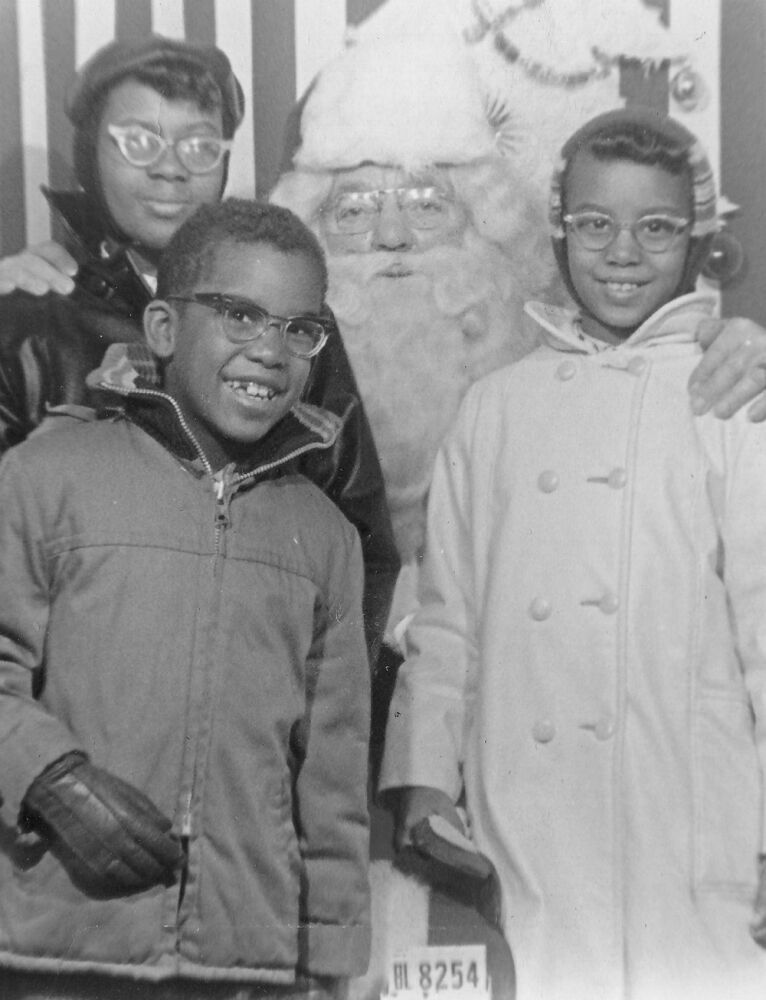
With his sisters, Pat (at left) and Donna (at right), and Santa Claus, Christmas 1959. Photograph courtesy of Darryl Pinckney.
INTERVIEWER
How do Chesnutt and Hurston fit into the sweep of the book?
PINCKNEY
Well, it begins with a brief description of books about African American writers through history, from Henri Grégoire in 1808 down to Darwin Turner in 1974. After Chesnutt is Claude McKay, who’s my favorite, and the influence of Primitivism on American literature. McKay went to Russia and looked at it and thought, Mm, perhaps not. Home to Harlem I find very interesting, but Banjo even more so, because it’s a picture of Marseilles in the twenties and of a very international black lumpenproletariat of seamen. And then there are two chapters on Hurston, her anthropology and her fiction. Zadie [Smith] remembers that Hurston’s books were on her mother’s shelf, but I think Nella Larsen’s fiction is more interesting than Hurston’s, or Jessie Fauset’s, whose books were of her period. But Larsen published only two novels, so she’s not really in the book, even though Passing is very interesting because the point of view is not of the character who is passing, it’s of someone who knows this secret and is looking at her, which gives Larsen a kind of freedom. Then it’s Langston Hughes, who really put together a professional career on the black side of town, which is important. And then two essays on Richard Wright. He chose the Russians as his literary antecedents, because the American nineteenth century had too much racism in it for him. Then there’s Ralph Ellison’s Invisible Man, Ralph Ellison after Invisible Man, the essays of James Baldwin, the novels of James Baldwin, Amiri Baraka, Ishmael Reed, Toni Morrison.
INTERVIEWER
I want to ask you a bit about the process of writing this book.
PINCKNEY
Why, am I taking too long describing the contents?