Issue 254, Winter 2025
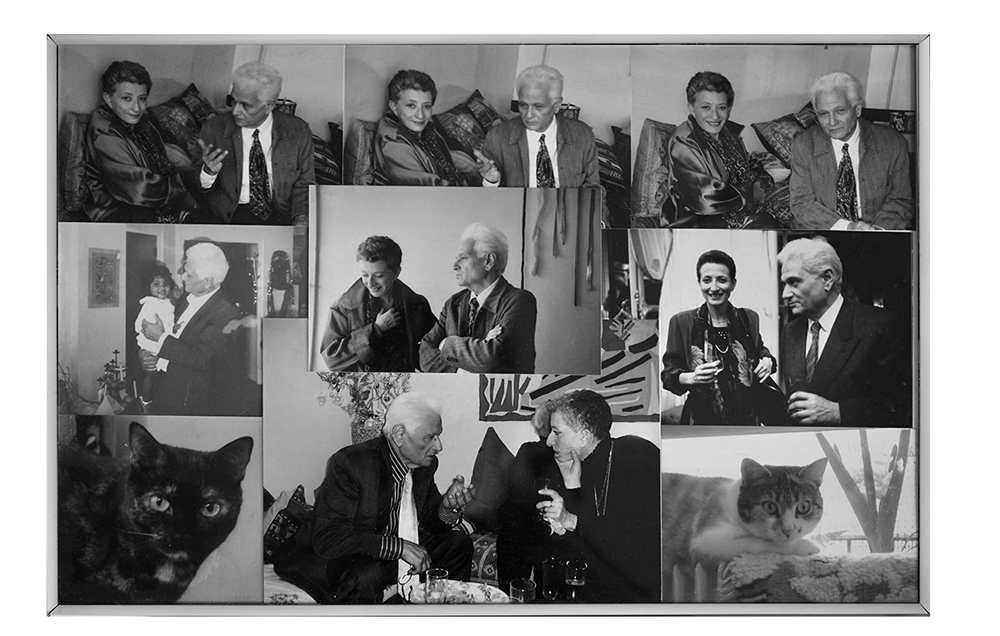
A collage of photographs of Cixous, Jacques Derrida, her granddaughter Saranya, and her cats Philia and Aletheia. Courtesy of Olivier Morel and Hélène Cixous.
Hélène Cixous has never called herself a critic. She tends to shrug off, too, the other appellations she might be given: philosopher, theorist, novelist, memoirist, feminist. In her most famous work, the 1975 essay “The Laugh of the Medusa,” however, she combined aspects of all these personae, exhorting women to harness their libidinal forces, the body’s rhythms and pleasures, simply by writing: “Woman must write her self: must write about women and bring women to writing, from which they have been driven away as violently as from their bodies … Writing is for you, you are for you; your body is yours, take it.” Today, Cixous sighs at questions about the essay that propelled her to a level of international fame unusual for a young academic, but “Medusa” called into being an idea, l’écriture féminine, that has influenced generations of new writers—and is more nuanced and more radical than the translation “women’s writing” might suggest.
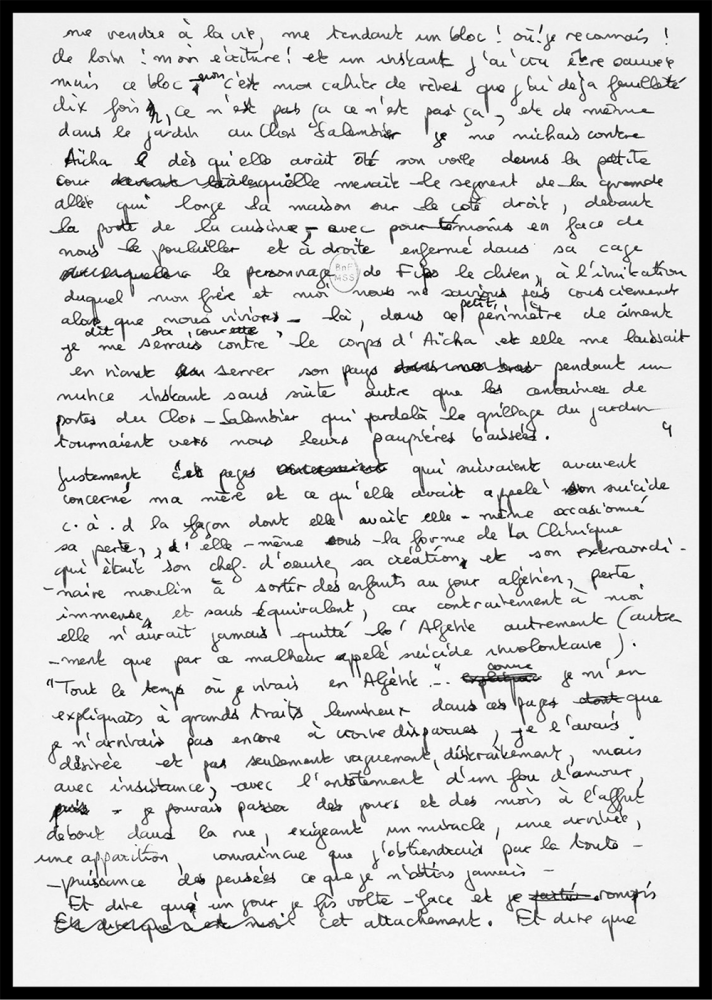
The best examples of what Cixous called “female-sexed texts,” which manifest the deconstruction of the masculine and hegemonic order even at the level of the sentence, have always been her own works of prose. At once poetic and idiomatic, suggestive and withholding, her writing eludes the rigid structures of what her close friend Jacques Derrida termed phallogocentrism, while also offering its own multivalent alternatives, often replete with puns, neologisms, metonymies, and homonyms. (It is also notoriously difficult to translate, a fact in which Cixous appears to take a certain pride. She has a handful of trusted translators; one of them, Eric Prenowitz, who Cixous requested review this interview, objected to how the transcripts had been compressed. He returned the draft meticulously revised.) By the time “Medusa” was published, Cixous was producing a book or two a year, each more idiosyncratic than the last. Inside (1969, translation 1986), which won the Prix Médicis, explores the loss of her father, who died of tuberculosis when she was ten. Angst (1977, 1985) traces its female narrator’s interior consciousness as she reminisces about her mother and navigates the linguistic entanglements of her male lover. In The Book of Promethea (1983, 1991), Cixous questions the sovereignty of an authorial self, as the first-person “I” and her “shadow,” H, wrestle with Promethea, the figure who “made the whole text.” Cixous’s interests in biography and the aurality of language can also be seen in her analyses of other writers, starting with her doctoral thesis, The Exile of James Joyce (1968, 1972), the first major study of the author in French, which, at 765 pages, was, as one reviewer pointed out at the time, longer than Ulysses.
Meanwhile, in books such as OR, les lettres de mon père (Gold, my father’s letters, 1997), Osnabrück Station to Jerusalem (2016, 2020), and Well-Kept Ruins (2020, 2022), Cixous has also excavated her family history. Cixous’s mother, Eve Klein, an Ashkenazi Jewish stenographer from northwest Germany, met her father, Georges Cixous, a doctor of Sephardic Jewish heritage, in Paris. They settled in Oran, Algeria, where Georges’s family had been living for generations as French citizens, and where Hélène was born in 1937. During the war, the Vichy government revoked citizenship from Algeria’s Jewish population, and Georges was forbidden to work. In her essay “How Not to Speak of Algeria,” Cixous describes the effect of the “repeated attacks against the two peoples to which my heart belonged: the Algerian people, an assailed, crushed, colonized, apartheided people, very numerous, reduced to serving the all-powerful but thinly present Empire, and the Jewish population, twenty times less numerous, stripped of its rights to live, and destined, in the connivance established between Vichyism and Nazism, for destruction.”
In 1968, after French students poured onto the streets of the Latin Quarter in an uprising that led to a general strike, Cixous, who was then teaching English literature at Nanterre University, was invited to found the Experimental University Center of Vincennes. Constructed in the Bois de Vincennes, the school, designed to address the protesters’ concerns, served as a utopian institution—a place where students needn’t have a baccalauréat, and where an architect, a secretary, and an engineer might find themselves in the same night class as their children played together in the university’s childcare center. Cixous taught at Vincennes—alongside faculty including Gilles Deleuze, Michel Foucault, Jean-François Lyotard, and Alain Badiou—for several decades, even after the school relocated to Saint-Denis in 1980. (It is still in operation, now known as Paris 8 University, though no longer as maverick as it once was.) Her hours-long seminars, in which she usually lectured without notes, have been collected in volumes including Readings: The Poetics of Blanchot, Joyce, Kafka, Kleist, Lispector, and Tsvetayeva (1991).
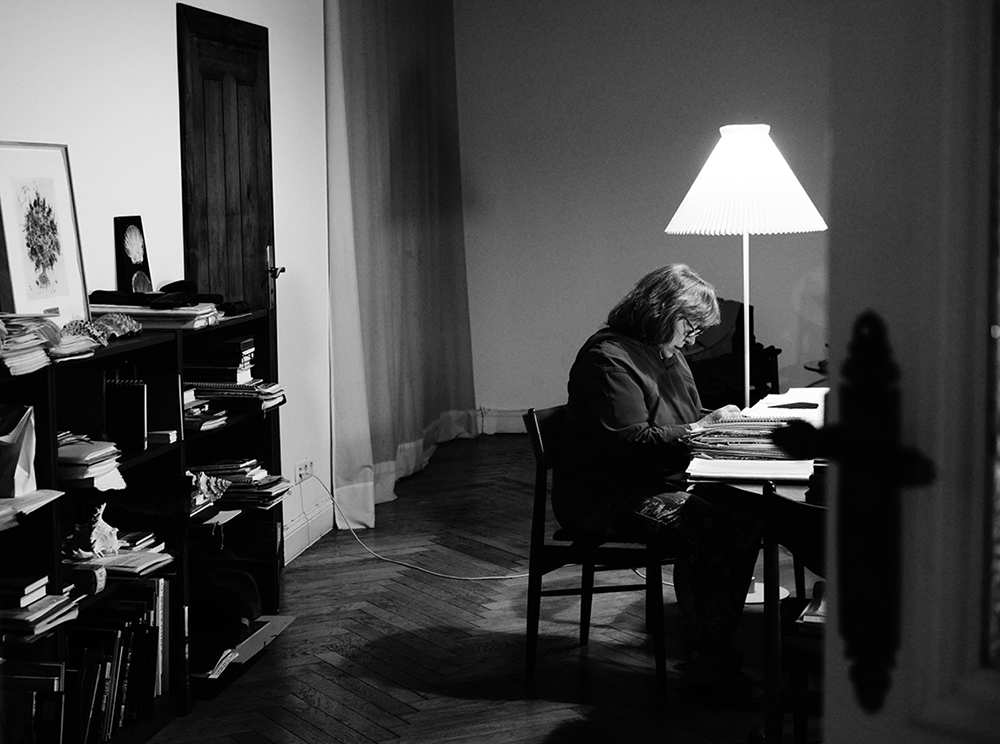
Cixous and I first spoke this past spring, in a phone call to arrange our in-person sessions. She was stern, though impish. When I asked whether she’d prefer to conduct our conversations in English or French, she asked, “Do you speak cat?” (We spoke a combination of the two, with Cixous occasionally addressing Haya, who often lay on the table between us.) We met four times at her tenth-floor apartment in Paris’s fourteenth arrondissement over the course of a week in May—during which temperatures soared and the elevators in her building stopped working—and had a follow-up session on Zoom in October. Her home is colorful, cluttered, and eccentric, adorned with a menagerie of decorative animals and puppets. Outside, potted geraniums and petunias fill a narrow balcony. Cixous alternated between strikingly different states of warmth and distance, at times generous and at others dismissive. Once, noticing that she’d left a glass of water on the table for my arrival, I found myself deeply moved.
INTERVIEWER
I’m struck by how your descriptions of your childhood often involve different ways of seeing. In “Savoir,” you describe your severe nearsightedness as a child, and the surgery that restored your vision. In other works, and in your lecture “Promised Cities,” you’ve also recalled looking out from the balcony of your family home in Oran onto the Place d’Armes—a living stage on which French colonialism and World War II were playing out in the late thirties and early forties. I’m wondering what was being staged. Who were the actors? And how did these different ways of seeing—
HÉLÈNE CIXOUS
Stop.
INTERVIEWER
Okay.
CIXOUS
I will gather this—though it’s a bit artificial—under the title of reading. I think I was reading the world. For me it was a book, but of course it wasn’t simply a book because, as you say, it really was a stage. My family lived as both spectators of and actors on a stage where huge historical events were taking place. We were on a balcony, and we saw everything. And I suppose I somehow integrated this—as soon as I started to be conscious, I began to perceive the world with a kind of permanent staging of what is happening. Maybe I was attentive also because I couldn’t see well. I had such difficulty adjusting to the visible that I was always intensely deciphering what was going on. These are different kinds of subjective relations to history, overdeterminations that probably enhanced each other.
When I think back … But I don’t really think. When I think, I think-see—the staging is always at work. So when I learned that Shakespeare had already said that the world is a stage, I thought, Of course! It’s a Shakespearean stage—that is, both a stage with props, very concrete, and a psychological, spiritual way of thinking philosophically about what mankind is, what humans are and what they do, what they perform or destroy … Shakespeare is a telescope for me, a telescope for the heart, for the soul. Whenever I witness tragic events, dramas, as a spectator, which is to say every day, they are immediately transposed—all that is historical or political is immediately Shakespeare for me. And although I admire and adore Shakespeare’s comedies, they are less vital for me, quite simply because we live in tragedy, we don’t live in a comedy.
INTERVIEWER
In “Savoir,” you describe how, after you “lost” your nearsightedness, you felt some nostalgia for it.
CIXOUS
I’ve always told myself that my myopia gave me something very precious, although it’s totally subjective, personal. I never saw myself. When I was growing up, mirrors were useless to me. I’ve always thought that was a good remedy against narcissism. I think it’s beneficial to not look at oneself, to never think of looking at oneself, because in any case it’s pointless. I recommend it.
Another thing that certainly was determined by my nearsightedness was my way of reading. Even now, when I have my glasses on, I can’t read, because these glasses are made for seeing far away. So in order to read, I have to do this. [Cixous takes off her glasses and holds a book six inches from her face.] Of course, that changes my approach to the text. To that point, I read very quickly, which does not mean that I do not read slowly. I read very slowly, quickly. Very quickly, slowly. I read a page in a single glance.
INTERVIEWER
Oh really?
CIXOUS
I turn to a page and—you can count the seconds—there, I’ve read it. It was my son who pointed this out to me. Later, of course, I read it differently several more times. That’s always how I read real texts, not newspapers. At least in French and English. In German I need more time.
INTERVIEWER
But isn’t German your mother tongue? You wrote, in “Coming to Writing,” “In German I sing; in English I disguise myself; and in French I fly, I thieve.”