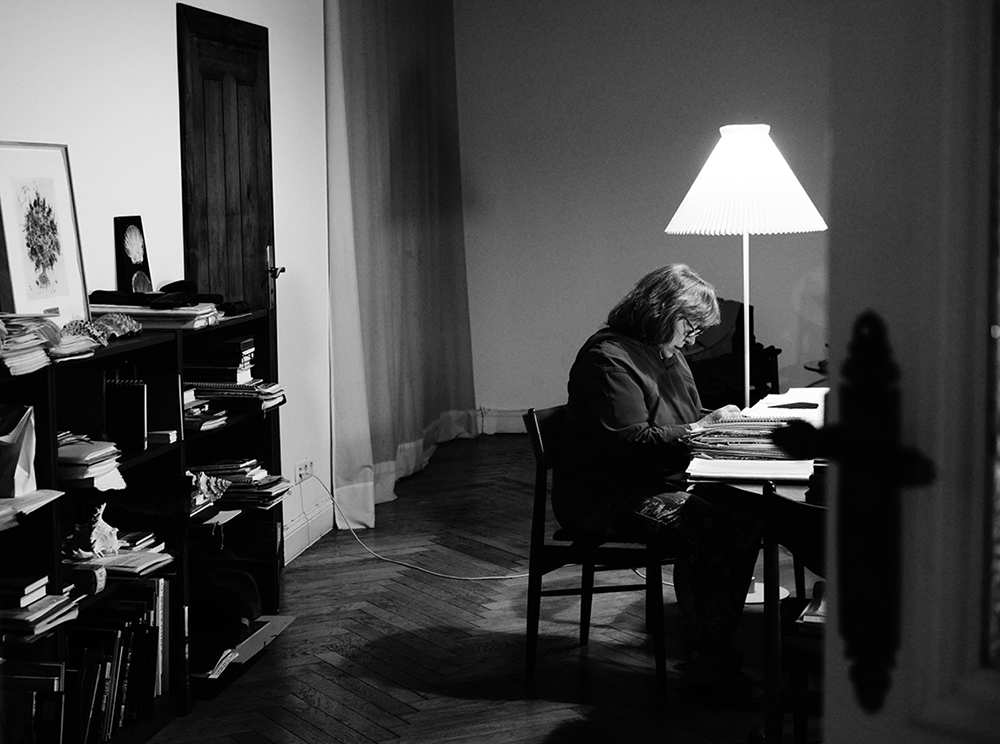
undefined

With Keith at home near Middletown, Connecticut, ca. 1966. Photograph by Walt Odets, courtesy of Rosmarie Waldrop.

I first heard Rosmarie Waldrop read when I was seventeen, visiting my elder brother at Brown. She was reading from what would become Reluctant Gravities (1999), the third book in the trilogy of prose poems later collected as Curves to the Apple (2006). I was utterly transfixed and utterly baffled. The sentences had familiar shapes—many had the arc and feel of logical propositions—and yet something strange and unaccountably beautiful had happened to them. Their vocabularies had shifted, often toward a more lyrical register, producing new arrays of music and significance while also somehow heightening my experience of grammar itself. In the nearly three decades since that first encounter, I have come to see that Waldrop’s experiments with found grammar—with taking sentences from, say, Wittgenstein, and then retrofitting them with new language—constitute an innovation on the order of Hannah Höch’s experiments in photomontage, or John Cage’s use of prepared pianos. On a warm day this past January, I took the train from New York to Providence to ask, among other things, how that breakthrough came about, and to piece together the genealogy of this poetic form.

Rosmarie Waldrop, née Sebald, was born in Kitzingen, Germany, in 1935 and migrated to the U.S. in 1958 to join Keith Waldrop, her soon-to-be husband and frequent collaborator, who was then a graduate student at the University of Michigan. After earning comparative literature degrees at the university, they spent a few years teaching at Wesleyan before settling in Providence in the late sixties. “In crossing the Atlantic my phonemes settled somewhere between German and English,” Waldrop has written. “I speak either language with an accent. This has saved me the illusion of being the master of language.” One continuity of her writing has been this alertness to discontinuity, to the fissures in a phrase or form. In A Key into the Language of America (1994), a poetic reworking of  Roger Williams’s 1643 study of the Narragansett language, she unsettles the colonial authority—masterfully undercuts the mastery—of the sentences she torques and splices and recombines into new configurations. In Lavish Absence: Recalling and Rereading Edmond Jabès (2002), Waldrop speaks of translating not only Jabès’s writing but “the silence behind it.” And carefully calibrated silences are everywhere in her work, including in the novel The Hanky of Pippin’s Daughter (1986), a beautifully orchestrated counterpoint of personal and collective histories, of the silences within a family and the silenced of Hitler’s Germany.

Waldrop is at once a towering figure—she has written some twenty-five books and has translated more than twenty from French and German, including the work of Paul Celan and Jacques Roubaud—and an unassuming one, suspicious of the grand political pronouncements of the avant-garde and, despite her reckoning with historical memory, more interested in the aleatory than the polemical. To the generations of writers who have passed through their home, the Waldrops have communicated, through their art and example, that a total commitment to literature is compatible with—perhaps depends upon—not taking yourself too seriously, that a lifelong devotion to poetry should involve a sense of its absurdity (or at least of the absurdity of poets). 

This mixture of rigor and playfulness also characterized the Waldrops’ work as publishers. For more than fifty years, Rosmarie and Keith ran the legendary small press Burning Deck—a DIY operation (the letterpress was in the basement of their house in Providence) that became a vital conduit for new writing from several languages. My favorite Burning Deck books include works by Lyn Hejinian, Mark McMorris, Marjorie Welish, Dallas Wiebe, and Mei-mei Berssenbrugge, but every poet I know has their own constellation of enabling titles published by the Waldrops. If Burning Deck had an orthodoxy, it was openness. 

And I have only ever known the front door to the Waldrops’ house to be unlocked—you let yourself in, but to a different world. The house is so full of books it seems made out of books, there is a fascinating object or artwork wherever you look, including many of Keith’s collages, and yet the house is neither cluttered nor overly curated. It is a kind of Wunderkammer gently organized by the sensibility of  “the third Waldrop,” to borrow a phrase from Roubaud, who was naming the author of  Rosmarie and Keith’s collaborative poems, which are collected in Well Well Reality (1998). Rosmarie and I spoke over two days in her living room, where countless visitors have been given a stack of Burning Deck books and good wine; she remains perilously quick to refill your glass. In my memory, Keith was there beside the fireplace, listening. In reality, he died in the summer of 2023.


INTERVIEWER

You’ve said that you first turned to collage to get away from writing poems about your “overwhelming mother.” But when you looked at the collage poems later, they were still about your mother!

ROSMARIE WALDROP

Yes. 

INTERVIEWER

In what way was she overwhelming? 

WALDROP

She had ideas about what I should be like, and they didn’t fit. They were about etiquette some, but more about character.

INTERVIEWER

Did she have a job?

WALDROP

No. She had wanted to be a singer, and she hoped that if her kids could learn to play the piano, they could accompany her singing. That did not work out with any of us three.

INTERVIEWER

Was she talented?

WALDROP

I have no idea. I was just irritated by the whole situation.

INTERVIEWER

Was part of her difficulty attributable to the sense of a frustrated artistic ambition?

WALDROP

Very likely.

INTERVIEWER

Somewhere you write about your mother, very late in her life, bursting into tears and saying you had no grandparents. Did you know her parents?

WALDROP

No. There was a photo of her and her mother carrying me in a kind of carrier between them. I couldn’t have been more than three or so. But I don’t remember my grandmother. My mother quarreled with all her family—and she had nine siblings!

INTERVIEWER

At least she was consistent. Was she the dominant personality at home?


undefined

Waldrop, at center, with her twin sisters, Dorle and Annelie, 1939. Courtesy of Rosmarie Waldrop.

WALDROP

Definitely. My father couldn’t stand up to my mother in anything, except money. He made a big mistake by never telling her what his salary was, so she always suspected that he had more than he was letting on, and that he had a mistress who was getting most of it.

INTERVIEWER

Tell me about your father.

WALDROP

He taught phys ed at the local high school. He read the German classics, which were in the house, and quoted Schiller constantly, without attribution. Once, when I was sick as a child, I started to read Schiller’s plays, and that was very amusing, because I recognized immediately all the things my father would say. He also read a lot about astrology. He was nominally Catholic, but really a pantheist. His Sunday devotion was to go out into the woods. 

INTERVIEWER

Is it true that one of your siblings thought of being a nun? What I know of them is from The Hanky of Pippin’s Daughter, so I might be confusing fact and fiction.

WALDROP

That was Annelie. She entered the Carmelite order, a very small convent of only twenty-four nuns. Her novitiate was very difficult, partly because she couldn’t shut up and they had a rule of silence. She sometimes had to wear a piece of wood strapped over her mouth. When it came to taking her vows, the convent voted against her. Thank God. But it crushed her. She had this big ambition to become a kind of saint, to spend her life praying, and that she was refused was very hard for her. She became a crusading anti-Catholic after that. Kitzingen, our town, was partly Catholic and partly Protestant, and the schools were divided by denomination.

INTERVIEWER

Did you know any Jewish people?

WALDROP

I did not. Jewish people, for me, were the ones in the Bible. Though some kids of my age did have encounters. I’ve talked with an old classmate about this, whether he had met any, and he told me a story about a time another classmate challenged him to say “Heil Hitler” to a particular Jewish woman who was known to always go to some store pretty late in the day. So, Bitz, the guy I thought of as my friend, did it, not quite understanding what he was doing. The woman just said “Grüß Gott,” which is a religious greeting—“May God greet you”—and carried on. Later, when he became aware of what he’d done, he was very ashamed. 

INTERVIEWER

What are your first memories of the war? Was it something you were kept from knowing about?

WALDROP

Oh, no, because Hitler was on the radio the whole time. I have an image of my father, my mother, and myself sitting after dinner at the little table and listening to Hitler’s speech. I remember the hysterical voice—going up and up and up and up and becoming hoarse and breaking. I just remember that sound event. When his speech was over, there was the declaration of war. My mother said, “Our leader will take care of it.” 

INTERVIEWER

“It’ll be quick.” 

WALDROP

Yes. I think she bet on four weeks. My father joined the Nazi Party because he didn’t want to get fired, but then he was taken in by Hitler. He thought Hitler would do something for the not-so-rich people. Gradually he cooled a little, but he was taken in by the rhetoric.

INTERVIEWER

How old were you when Kitzingen was bombed?

WALDROP

It was in February 1945—I was nine and a half. 

INTERVIEWER

Do you remember being terrified? Or were you somehow oblivious to the extremity?

WALDROP

No, I was terrified, and so were the grown-ups from all five floors of the building, racing down to the cellar at the first sound of the alarm for planes approaching. What I remember is that I was trying to burrow into a heap of potatoes on the cellar floor. I just wanted to hide down deeper. The town was largely destroyed. I remember my sisters went out after one of those attacks and helped dig up corpses, and afterward they came home and both started throwing up. It was a change of my world to come out of the cellar and find that there was no street and very few houses. Most of the houses around were rubble. Our home wasn’t, except all the windows were of course blown out. That’s why we started wandering from village to village. We couldn’t stay in that apartment. Nobody was fixing windows.

 

undefined

In her early thirties. Photograph by Heinz Puppe, courtesy of Rosmarie Waldrop.

INTERVIEWER

Where did you go?

WALDROP

We stayed with acquaintances that my parents had. They weren’t always happy to see us. But the villages were fun, especially the animals I would help tend—I hadn’t encountered them before. But there were always sirens going off. My sisters, of course, had been drafted. One of them worked in an ammunitions factory, and the other was in a Flak unit. 

INTERVIEWER

Was your father in the army, or was he with you? 

WALDROP

He was with us. He was exempt from the army during the war because he was needed to train the young men to be in good shape to get slaughtered. While we were in the villages he would bicycle back and forth to our apartment to get objects that could be bartered for food or shelter. I spent most of that time with my mother. When we ran out of items of interest to farmers, my father started to draw greeting cards, which my sisters and I colored. After the bombing in February 1945, schools in my town didn’t reopen until the following January. 

INTERVIEWER

Am I making this up, or was there a moment when you joined a theater troupe?

WALDROP

That was after the war. The troupe had managed to get hold of a U.S. Army truck. They advertised for children to audition for the dwarves in Snow White. My mother saw the ad and immediately packed me up and took me to the tryout. I got the part, and for a few months I was shuttled from town to village to village to town, performing. This was without my mother. In the afternoons we did Snow White and in the evenings we did a play called The Love Potion. The potion worked so long as you didn’t think of a bear! In that, I was Alioscha, the son of a Russian nobleman. I was very proud when, after a week, I was given an honorarium. There was also the strange moment when I recognized one of the stagehands as a man I had seen racing up the stairs of our apartment house to the attic, where Frau Beikiefer apparently was hiding him. I didn’t know then whom he had been running from. Nobody had followed him up the stairs. Now, when he saw me staring at him, he put his finger to his lips. 

INTERVIEWER

Was the theater a meaningful early encounter with art and its possibilities, or just the insane circumstance in which you found yourself?

WALDROP

Initially it was intriguing and very exciting, but I soon found it boring. I remember getting lectured by the director that you must do your best in every performance. 

INTERVIEWER

Did you have a sense, growing up, of wanting to write?

WALDROP

Reading was my refuge from the family, but I didn’t yet have the ambition to be a writer. I was writing a little, because Annelie was writing, and I was emulating her. She wrote stories and newspaper articles about what she had experienced of the war—I think it was helping her to process things. She was nine years older, and had been much more conscious of what was going on. She wrote about the brainwashing especially—how, for instance, when she was twelve, her school class had gone to throw stones when the Jewish school let the kids out. Or about working in the ammunitions factory alongside Polish prisoners of war.

INTERVIEWER

How was the cataclysm of the war narrated to you? Was there silence? Penance? Fury?

WALDROP

I don’t remember much explanation or taking stock of what happened. At school, history classes went no further than the end of World War I. In high school, my friends and I did talk about it. We were naive enough to think, This has been so terrible that there will be no war or anything like this ever again. But my parents certainly didn’t talk to me about the war. I remember when I was twelve or thirteen, I came across my first book on the concentration camps, and my mother took it away. 

INTERVIEWER

Because you weren’t ready?

WALDROP

Right. The wider narrative was instead about being downtrodden and trying to rebuild. It is true that resources were limited in those first postwar years, until the currency reform in ’48. Many people were out of jobs, waiting to be denazified. 

INTERVIEWER

How did you get whatever books you had?

WALDROP

Rilke’s books were in the house because of Annelie. And there were a few shelves of books at the high school, but nothing like a real library. The church had a rec room for young people where they had some, mostly novels about the persecution of the early Christians, like Ben-Hur and Fabiola. It was a prejudiced selection, but I gobbled it all up. Most important, I made friends with a bookseller in town, who gave me borrowing privileges if I returned the books in pristine condition.

INTERVIEWER

I assume you had more access to books in college. Where did you go—did you follow your sisters?


undefined

Providence, Rhode Island, 1975. Courtesy of Rosmarie Waldrop.

WALDROP

My sisters never went, and they resented that very much. I don’t know how I persuaded my parents to let me go. My father at first said, “Well, you’ll marry anyway.” But then, somehow, I managed. I went first to the University of Würzburg, which was only a twenty-minute train ride away—I could commute from home, which made it cheap. Later I went to Freiburg, which helped because I could be away from my family. I was studying both English and French literature—it was there that I encountered Musil, too. The instructor who taught the contemporary novel said The Man Without Qualities was a great book but that he felt unequal to teaching it. So I went after it. 

INTERVIEWER

Had you met Keith by this point?

WALDROP

I met him in ’54, at the end of my first semester at Würzburg. He was stationed at a U.S. Army base nearby.

INTERVIEWER

How does a young German college student meet an American soldier? Not that I can quite think of Keith as a soldier.

WALDROP

It was pretty unlikely. Even just his shaved head! Well, starting in high school, we had this little youth orchestra, because one of my classmates wanted to be a conductor and rounded up everybody who could play an instrument. That year there were still enough of us in Kitzingen, so we gave a Christmas concert for the Americans. There were more people in our choir and orchestra than in the audience. Afterward, we were invited for coffee and doughnuts, and suddenly there were hordes of Americans who wanted to talk to us. That’s how Keith invited me and some of my friends to come up to the army base to listen to his records, mostly classical. We were all very excited, because none of us had any records. So at first we went up to the army base, but after one or two times, we said to him, “Why don’t you come into town? This is really an uncomfortable place.” After that, Keith would carry his portable player to one of our parents’ houses. 

INTERVIEWER

Was that a normal thing for an American to do?

WALDROP

No. I don’t think anybody else did that kind of thing.

INTERVIEWER

What was your English like at that point?

WALDROP

A little basic, but we’d had to learn English since age ten. 

INTERVIEWER

Did you two immediately have a connection, a serious interest in each other?

WALDROP

It happened fairly quickly. Keith started asking me to go to the Würzburg opera with him and proposed some other things that I wasn’t interested in. We really clicked when he suggested we translate German poems together. From then on, we met, the two of us, at my house. My mother would come and bring us cookies. But mostly, we were just in my room translating.

INTERVIEWER

What were you translating?

WALDROP

The first thing we translated was a poem of Nietzsche’s. Then some Expressionists like Georg Trakl, Georg Heym, Jakob van Hoddis, Else Lasker-Schüler. I chose the poets—Keith didn’t arrive with ideas of whom he wanted to translate. He connected most with Trakl.

INTERVIEWER

Were you writing poems?

WALDROP

Yes, in German. Some of them were Rilke imitations. I thought of Keith as a real writer, but I was lacking confidence, totally unsure that I could do that kind of thing. I had shown my poems to one of my rather good high school teachers, and he’d said, “Why don’t you learn something before you try to write?” 

INTERVIEWER

How did you and Keith find your way to the U.S. together?

WALDROP

Keith went back alone first, but we stayed in touch by letter. At some point, he wrote that he had gotten a G.I. Bill and could study abroad on it. He had figured out that he could get in to the Aix-Marseille University for the school year of 1956 to 1957, and he wrote me, “Can you manage to go there also?” That’s what I did. At the end of the year he went back to Michigan, and shortly after, in the summer of  ’58, Keith won the Hopwood Award, sent me four hundred dollars, and said, “Come.” I was a little scared, but my mind was made up very quickly. 

INTERVIEWER

Did you have a sense of how long you would be away?

WALDROP

Forever. I told my family that I was going to marry this guy. My mother reacted with horror and said, “And I thought I was so safe with him.” He met me in New York and then we got on the bus to Michigan.

INTERVIEWER

Did you and Keith have a wedding?

WALDROP

Yes, but we didn’t invite anyone. We wanted to do it quickly, because if  Keith was married he’d get twenty-five dollars more a month on the G.I. Bill—not as piddling a sum as it sounds now. Annelie was still in the convent, so if I hadn’t had a Catholic wedding, it would have added to her many problems. When we told the priest in Michigan that we wanted to get married, he said, “Not so fast.” He was satisfied with me being Catholic, but when Keith said he was agnostic, he said, “I hope you at least have been baptized?” Keith said, “Not as far as I know,” which the priest did not seem to hear. Keith had to suffer through some Catholic instruction. At the end, he was required to sign a statement that our children would be Catholic. He was worried, but I said, “We’ve pretty much decided not to have children, so go ahead.” 

INTERVIEWER

I’m curious, did you ever meet Keith’s mom?

WALDROP

Yes. Right when I came over we went to visit. His family was in Illinois by that time. But she was a little wary of me, you know. She was heard saying on the phone, “I have three sons—two married witches, and one married a Catholic!”

INTERVIEWER

I wonder which is worse.

WALDROP

It was clear. Though I didn’t tell her that was no longer a problem.

INTERVIEWER

Did you become a doctoral student at Michigan immediately?

WALDROP

No, I had to establish Michigan residency first to get in-state tuition, so I worked in the office of a car-repair shop. I started school the next fall, in comparative literature. I was amazed that Keith had already gathered such an entourage.

INTERVIEWER

Who was in that group?

WALDROP

X. J. Kennedy rather dominated the group at that time. He was the first to get a book published. I was most intrigued by Dallas Wiebe, because he was always sardonic. When I arrived he was writing poems that were less adventurous, but his prose was wonderful. Plus there were the composers Robert Ashley and Gordon Mumma. W. D. Snodgrass somehow got wind of us, and he would come over from Detroit. And more of Keith’s fellow grad students—James Camp, Christopher Longyear. I was the only woman. I think that’s just how it happened. I had no problem with one-to-one conversations in English, but when they started talking to one another, I’d think I’d lost my English, because I didn’t have the references that they tossed around. I avidly started learning.

INTERVIEWER

Were you reading their work?

WALDROP

Well, there were constant group meetings where we read to one another. 

INTERVIEWER

Were you sharing your own poems?


undefined

Back row: Arlette Jabès. Second row: Raquel Levi, Joseph Guglielmi, Emmanuel Hocquard, Anne-Marie Albiach, Adolfo Fernandez-Zoïla. Third row: Rosmarie Waldrop, Thérèse Bonnelalbay, Maryvonne Guet, Edmond Jabès. Bottom: Keith Waldrop. Jabèses’ home in Paris, ca. 1976. Courtesy of Rosmarie Waldrop.

WALDROP

Not at first. I was still trying to write in German, and it wasn’t working anymore. And everyone’s critique in these meetings was mostly quite harsh and cutting. I was impressed by how they were not pulling their punches. Keith was on the quiet side, so he was not very vociferous, but Dallas was, and James Camp, also. 

INTERVIEWER

Why weren’t the German poems working?

WALDROP

I just got blocked. I couldn’t do it. I at first attributed it to living totally in English. But I came to think that a major cause was that I didn’t yet have a base of my own work to build on. I kept reading in German, but that wasn’t enough, apparently. So I started writing in English.

My first poems in English were aphoristic, and they weren’t enjambed. I won the Hopwood a few years after we got there, actually, with a manuscript of those. We were always short of money, and it was an incentive to put a manuscript together. I think some of those ended up in The Aggressive Ways of the Casual Stranger (1972). Keith put a few of them in the second issue of Burning Deck magazine.


undefined

Clockwise from left, Rosmarie Waldrop, Keith Waldrop, Mary Oppen, and George Oppen at the Oppens’ home in San Francisco, 1979. Courtesy of Rosmarie Waldrop.

INTERVIEWER

It’s funny how significantly literary prizes figure in the history of the Waldrops, given that I’ve never met people less concerned with such things. And yet it occurs to me to ask—was there ever a sense of competition between you and Keith?

WALDROP

Keith was the most noncompetitive person in the world, I think. And he was always totally encouraging. It’s possible to coexist even if both people write. We were supportive of each other. We gave each other frank feedback. And writing collaboratively was fun. When we were writing the poems in Well Well Reality, we did have total control over our parts, but it was hard to disentangle them by the end. Those collaborations allowed us to play with each other’s manners a bit, and I liked that. 

INTERVIEWER

How would you describe the differences between your manners?

WALDROP

Well, Keith had really catholic taste, for one—he loved Robert Duncan, for example, and I didn’t at all. 

INTERVIEWER

Who were the English-language poets whose influence you felt was tutelary or significant?

WALDROP

Robert Creeley—I heard him read at Wayne State, and that was a revelation. Keith was teaching there while Snodgrass was on leave—he had recommended Keith to replace him—and Keith picked Creeley, Duncan, and Philip Levine to read at its poetry festival. The way Creeley read the line ends was amazing, articulating those pauses, all that silence, but still keeping the arc of the sentence going. It brought home for me that a poem is essentially embedded in a matrix of silence. So that even if the words celebrate what is, each line end acknowledges what is not. Donald Hall, whom I took a tutorial with at Michigan, did the opposite—he read straight through the break. His sense of rhythm was so different from mine, but I still learned from him, for instance about leanness, cutting out words. 

Also Emily Dickinson’s smallness, her very mysterious sequences. And Gertrude Stein, though at first I had some problems with her. But her writing grew on me. I came to her through her theoretical writings, like How to Write. Then, outside classrooms, we were reading the Modernists. Besides the meetings where we read our own poems, we had a Pound society, a Stevens society, and a Joyce society, where we read their texts out loud.

Since we’re talking of revelations, I should say I saw Merce Cunningham in Ann Arbor. He and his dancers moved against the beat of the music, whereas all dance I had seen before had moved with it. There was this disjunction at the center of his dances that opened up another space for me in writing.

INTERVIEWER

I think of John Cage as someone who comes up for you, too.

WALDROP

Yes, his aleatory procedure was important. Keith and I knew Cage slightly—he was at Wesleyan for a year while we were there. He was a little hard to get to, but we met him on a ridiculous evening, at a dinner to which one of the architects there had happened to invite him but also us. We were very excited. Then the host, immediately after eating, proposed that we play a game of twenty questions. Keith and I were livid—we’d hoped that finally we could talk. But Cage just laughed and said, “Why not?” He didn’t say, “This would bore me excessively.” He was a wonderful guy. He had that mixture of  being serious and unserious at the same time. After one of his performances on the campus, a student said, “What you just did, any kid could do,” and he said, “Sure, they could, but they don’t seem to be doing it.”

INTERVIEWER

What was it like being on that campus in the sixties? 

WALDROP

I was teaching German, in a sort of comparative literature program for undergraduates. There were several incidents. One was that a group of students wanted to invite a neo-Nazi to speak on campus. That had everybody in an uproar. The German department eventually convinced them not to do it, because it would constitute support, both monetarily and in giving him a platform.

In my classes, I was very surprised that Vietnam basically meant nothing to some of my students. I remember asking, “How old were you when it began?” They had been around ten. I said, “When I was ten, I was very aware of what was going on.” But then they said, “Well, it was just images on TV.” And that sounds convincing—that’s one of the consequences of our technology. But after the Kent State shooting, there was a big demonstration on campus, where classes were suspended and all the students assembled on the green.


undefined

Rosmarie and Keith Waldrop working at the Burning Deck letterpress in their basement in Providence, ca. 1981. Courtesy of Rosmarie Waldrop.

INTERVIEWER

How did politics enter the poems you and Keith were writing?

WALDROP

I don’t think about this kind of question while I’m writing. I’m simply trying to make a structure that works. It’s after I finish something that I realize, This is actually a feminist statement—or something like that. In A Key into the Language of America, colonialism and imperialism are the dominant ideas, but they get torqued through the form. The flipping of object into subject in the poems that came before The Reproduction of Profiles (1987), like in The Aggressive Ways of the Casual Stranger, was a feminist revolt against the male gaze, but I didn’t realize or at least didn’t articulate it to myself until the writing was done. Whatever occupies your head will get into your poems.

Politics enter Keith’s poems only occasionally—sort of obliquely. I remember a poem from that time, “Two Reports,” where he talks about his students going out and confronting cannons, confronting metal or something. But mostly he refused to bother with what was going on, which was frustrating for me.

INTERVIEWER

There’s the question of gender politics in your prose poems, too—the way you take Wittgenstein’s syntax, the philosophical proposition and its association with reason, and insert the kind of emotive and lyrical language that has traditionally been coded as feminine. Was there something about Wittgenstein’s syntax that pulled you in?

WALDROP

It was what I had at hand. At the time I began writing The Reproduction of Profiles, Keith and I had just come to Paris, and I had brought three books—Mei-mei Berssenbrugge’s The Heat Bird, Kafka’s Stories, and a German–English bilingual edition of Wittgenstein’s Tractatus, the latter because the Jabès volume I was translating had a quote from Wittgenstein. I’m very afraid of the blank page—I clamp up—so I started writing by putting phrases from those three books on paper. And Wittgenstein’s language is very nice. It’s very stimulating.

INTERVIEWER

Where did this idea of using found syntax to generate poems come from? Had anyone done it before? 

WALDROP

I don’t know, but most everything has been done before. It may be an Oulipo method—I’d read Raymond Queneau, Jacques Roubaud, Harry Mathews. 

INTERVIEWER

I see. The Oulipo N+7 stuff is kind of similar—where you replace each noun in a text with the noun that’s seven entries away in the dictionary …

WALDROP

Yes. I’d started using that kind of approach with When They Have Senses (1980), which was based directly on Anne-Marie Albiach’s book État. It was a good challenge, using her syntax as a matrix. That was very interesting because French syntax is so different from the English. 

INTERVIEWER

You’re literally taking the syntax of the French poem and then substituting your own English vocabulary—so where the verb is in the French is where you place the English verb in your poem, and so on? 

WALDROP

That’s how it begins, but it immediately runs into snags. Doing it word for word didn’t work, and it forced me to think again. You know, I almost always start with a procedure, but if  I make the rule, I also break it, play with it, manipulate it. 

INTERVIEWER

Anne-Marie Albiach’s photo is right here on the shelf. How did you come across her work? 

WALDROP

Well, in the early seventies, Keith and I lived in Paris for a year. We spent the fall of 1970 very much by ourselves, but we got a lot of writing done—I was starting to write “As If We Didn’t Have to Talk,” and translating Jabès’s The Book of Questions (1963, translation 1972). My fellowship required me to write a critical work, but I was writing poems instead. After a few months of this, we ran into an old student of  Keith’s, George Tysh. He looked around the two rather large rooms we had and said, “You know, I used to host readings for Americans who come through Paris, but now I’m living on a friend’s couch. Would you be willing to host?” The first reading was David Rosenberg and Robert Hébert. Anne-Marie and Claude Royet-Journoud, who were married at the time, came. Claude told us that Anne-Marie’s first book had just come out. When everybody left, Keith said, “Let’s go to Le Drugstore and look for it.” I said, “You’re crazy, a place like that wouldn’t have new poetry.” And it was past midnight. But in Le Drugstore there was a table of new books, and on it was Anne-Marie’s État. I think Keith started reading it that very night. We both sensed an incredible energy in it. It seemed to be pulsing with an intense life.

INTERVIEWER

That was a crucial encounter for you and Keith. 

WALDROP

Yes, we spent whole nights talking with Claude and Anne-Marie, mostly in French. Even the group in Ann Arbor had nothing like the intensity of talking with those two. Anne-Marie, and Claude, too, had a complex relationship with analogy, which interested me very much, and made me aware of what I’d been doing in “As If We Didn’t Have to Talk.” I knew something was happening in the poem that I liked, but it took talking with them to realize what it was—I wasn’t writing in explicit metaphor, but I was setting walking and writing in metaphorical relation. In other words, I was pushing metaphor out of the texture of the poem and into its structure. That realization was very important.

It was also at the reading, while we had some wine and cheese, that Keith mentioned I’d started translating The Book of Questions. That book was an overwhelming experience for me. Derrida has an essay in which he says that “in the last ten years nothing of interest has been written in France that does not have its precedent somewhere in the texts of Jabès.” In any case, hearing this, Claude shot across the room and kissed me. That was surprising.

INTERVIEWER

Because of the Jabès?

WALDROP

Yes. He said, “I must kiss you because you’re translating Jabès.” And he rushed to the phone to try to get Jabès on the line, but it was beyond his bedtime.  


undefined

With Lee Ann Brown, the publisher of Tender Buttons Press, upon the publication of Lawn of Excluded Middle, 1993. Courtesy of Rosmarie Waldrop.

INTERVIEWER

And did they later introduce you to Jabès?

WALDROP

They did—in fact, the day after that first reading. Claude brought him by our place, and I handed him the fifty-some pages I had done of his text in my English. I’d sent them as a sample to a number of publishers and they’d all said no, so I’d been discouraged, but I’d taken the manuscript along to Paris in case, you know. 

INTERVIEWER

How was Jabès’s English? 

WALDROP

It was actually fairly good, but he always said, “My English is army English”—he’d served in Egypt’s British army—and refused to talk about his work in anything but French. He could read English pretty well, though, and his wife, Arlette, was fluent—she worked at a nuclear research institute. They were very warm, and we all became friends very fast.

INTERVIEWER

You went on to write a book on Jabès and translation, Lavish Absence—but I also think of him as someone who influenced your poetry, who attuned you to the book as a form. 

WALDROP

Yes, definitely.

INTERVIEWER

Is it accurate to say that, for you, part of the power of Jabès—an Egyptian Jewish writer—had to do with your having grown up during the Holocaust? 

WALDROP

That is no doubt right. I have come to think that my preoccupation with silence, even the small silences that open up in every disjunction, lies in the fact that for me these silences connect to a different silence, the silence of the voices I should have heard as I grew up in Germany and could not—the voices of the murdered Jews and the other dead of the Nazi regime and World War II. And to the gap between what I had experienced and what had happened around me. It haunts me.

On the other hand, I didn’t want to translate Elie Wiesel, or other Holocaust writers. I think the power of The Book of Questions lies in its remarkable form, in which poems are alternated with narration, aphorisms, rabbinical dialogues, meditations, and, above all, white space in between. But maybe it comes out to the same thing. It is silence that both is the matrix of the work and is made visible in the work. It is crucial both to its form and to the emotional power it has for me.

INTERVIEWER

Do you have a particular philosophy of translation?


undefined

Clockwise from bottom left, Damon Krukowski, Mark McMorris, Peter Gizzi, and Waldrop in Providence, 1994. Courtesy of Rosmarie Waldrop.

WALDROP

One thing I’ve found useful is a very practical method used by the critic Justin O’Brien. His approach was to at first just make a literal translation, and then put the original away and treat the translation like it’s your own poem. Then look at the original versus your translation and wrestle the translation back toward the original. I have followed that procedure myself.

And Lawrence Venuti drew my attention to Schleiermacher, who said that translation ought to be foreignizing. But of course Schleiermacher said this with a political intent, because he felt the German language needed enrichment—that compared to French it was lumbering, so bringing in French vocabulary and structure would benefit it. That was the early nineteenth century, during a very nationalist moment in Germany. But I think this is a good thing to think about, because if a translation is not altogether smooth, it makes the reader read more slowly.

INTERVIEWER

Is this slow reading a version of Modernist difficulty?


undefined

With James Laughlin, 2001. Courtesy of Rosmarie Waldrop.

WALDROP

I want to slow people down in the reading, but I’m not striving for difficulty. It puzzles me that people say my work is difficult. If you read it, it’s very simple. In a form like painting, difficulty is better tolerated than in poetry—I guess because people use language every day, and poems go against the grain of its normal use.

INTERVIEWER

The Language poets argued that disrupting conventional habits of reading was a political project. But I don’t think of you as belonging to that school, even though Burning Deck published many important texts associated with Language poetry.

WALDROP

No, and they never considered me a part of their group, either … But it’s quite all right to be elsewhere. The eclecticism of  Burning Deck is rampant. Keith refused to side with either the Beats or the academics. In fact, the trigger for Burning Deck magazine was the war of the anthologies in the early sixties—there wasn’t a single poet who appeared in both Donald Allen’s The New American Poetry and The New Poets of England and America, edited by Donald Hall, Robert Pack, and Louis Simpson. After we stopped the magazine—we managed only four issues in five years, and printing costs were higher in the Northeast than in Michigan—we decided to print a chapbook whenever we could get around to it. We also agreed that, with our very limited means, and only occasional publication, Keith’s catholic taste would produce a mere scatter effect, and that we instead would focus on experimental writing, which was our main interest in any case. 

INTERVIEWER

How did you keep the press afloat?

WALDROP

Until we came to Providence, there were only two or maybe three chapbooks a year, and those were poems by me and Keith and friends, which we sent out as Christmas cards. In 1970 we printed eleven, because the recently founded NEA had just begun funding small presses and magazines. Once the NEA got less interested in grassroots publishing, we turned to sustaining the press by selling our archive.

INTERVIEWER

I remember when I was a senior at Brown I took a copy of Marjorie Welish’s The Windows Flew Open from your basement, and the night I read it I wrote the first ten of my Lichtenberg Figures in the margins. You gave away so many books.

WALDROP

Well, we would rather have sold them. But we didn’t want them to rot in the basement, so we got them out into the world. 

INTERVIEWER

Were you interested in building a literary community?

WALDROP

We were interested in texts. The community-building was a welcome side effect.

INTERVIEWER

In what ways did your work with Burning Deck influence your own writing or thinking?

WALDROP

It was actually the printing that was the big lesson. We’d bought a letterpress for a hundred dollars, at the moment when print shops were turning to offset printing and getting rid of their equipment very cheaply. We tried to learn from a high school manual, through trial and error and a local printer’s advice. Because the type was so slow to set, there was a lesson in being lean, and a big lesson in close reading. I liked the practical side—printing, reading, writing—much more than I liked the academic world. It’s stimulating to have a lot of manuscripts come your way that you might not see otherwise. 

INTERVIEWER

Were you very hands-on as an editor?

WALDROP

We both got enough of nursing poets and poems when we were teaching, so we accepted only manuscripts that were really finished and needed minimal editing. I first read Lyn [Hejinian]’s poems in a little magazine called Diana’s Bimonthly that was published by Tom Ahern, who was living in our attic in Providence. It was reading those early poems that made me write to her and ask if she had a manuscript. She sent My Life

INTERVIEWER

That must have been an exciting manuscript to get in the mail.


undefined

San Francisco, 2011. Photograph by Walt Odets, courtesy of Rosmarie Waldrop.

WALDROP

I hadn’t seen anything like it. No writer we published had as much relation to my writing as Lyn, or Mei-mei Berssenbrugge. When I look at magazines now, a lot of the prose poems are really short short stories, and a lot of them lack the tension, the condensation, that I think a poem needs.

INTERVIEWER

How did the prose poem begin to crystallize for you? You’ve told me about found syntax, but when did that strategy migrate from verse to prose?

WALDROP

It was via the novel The Hanky of Pippin’s Daughter. Keith and I spent a sabbatical in Berlin, and the language I heard around me was my Prussian mother’s language. That brought back lots of memories and made me realize that I needed to write a novel that dealt with my childhood and the war. 

INTERVIEWER

Did your family ever read Hanky?

WALDROP

My sisters did. Only Dorle had English, so she translated part of it for Annelie. My parents didn’t have English, so I was pretty safe.

INTERVIEWER

Was that maybe a condition of the possibility of writing for you?

WALDROP

It may have been. It was a huge thing to try to tackle. It took me eight years to write, with many false starts. In any case, I think it was struggling with that book, working on prose all that time, that caused the poems in The Reproduction of Profiles to be in prose.

INTERVIEWER

What was so difficult about Hanky—the historical material feeling overwhelming?

WALDROP

Yes, and it was hard to find the proper form for it. I came to understand that I could do it only from the margins, by focusing on something small. It was when I found this idea of writing section titles that could also be part of sentences—pulling those out typographically from the rest of the text—that the writing started to flow. 

INTERVIEWER

Those section titles in the book—the way they are both inside and outside the narrative—create order and disrupt it simultaneously. What gave you the idea?

WALDROP

That might have been from Johannes Bobrowski, a Prussian poet, and his novel Levin’s Mill, which is remarkable. After a paragraph or so, it says, “All right, that’s the first sentence.” And then maybe five pages later, “Well, that’s the second sentence.” 

I feel this is a constant behind all my work—the conflicting impulses toward continuity and fragmentation. One impulse is to have an open, unstructured space for the poem, and the other is to fragment, with interruption. I’m always balancing those, and I’m trying in the prose poems to have both—to have interruptions within a sentence, by putting a period where, grammatically, it shouldn’t be.

INTERVIEWER

How did you move away from the lineated sequences of the earlier poems, after Hanky?

WALDROP

Well, my lines had gotten very short, and the propositional sentences I started writing in The Reproduction of Profiles were a kind of reaction to the poems I’d been writing before, in The Road Is Everywhere or Stop This Body (1978)—that flow where there’s no end to the sentence but a lot of  flipping the object of one phrase into being the subject of the next, which makes you stop a second. But at the same time it creates an unending sentence. I loved this device because it made for great speed. But it was also limiting because it allowed for only main clauses—I called it main-clause highway. So I began to hanker for subordinate clauses, complex sentences.

INTERVIEWER

Did you know when you began The Reproduction of Profiles that it would be the first book of a trilogy?

WALDROP

No, that came as a surprise to me. Every book I’d completed had been followed by what Jabès calls the book of torment—when you’re finished, you think you will never be able to write another line. But when The Reproduction of Profiles was done, I kept having lines from it run through my head, and I thought, This could go on.